Wednesday, September 30, 2015

Gryeka, 2002-2015

Stone Hill, June 2015
Life gets back to normal in autumn. This year Mila started third grade, I’m teaching my first fall semester class and finishing the book, Olga is chairing her department. I’m coaching Mila’s U10 soccer team, and already starting to look ahead to hockey season. In September we picked up much of the same routine as last spring — waking up, packing the kid's bag, heading out the door, walking the the two long blocks to the elementary school, saying ‘hi’ to Bill the crossing guard along the way. We get to her new classroom — her first on the building’s second floor, and we say good-bye for the day. Then Olga continues on to the college for her day, and I walk back home as I always have, and it is perfectly empty when I get there. 

I knew when we lost Gryeka back in June, after a sharp decline to complete a long illness, that life for awhile would be these sharp shocks. I had a long, sad summer to get used to not having our dog waiting for us. Olga and Mila were away in Moscow, I had work to do, I took some time away. I got used to coming back to the beastly empty home, and knowing that there was no need to rush back if I was away, or to hurry awake in the morning to take him out.

The first steps of mourning are getting used to the sudden hole punched in your present, and adjusting to the way that hole you project into your present. It was hard for me to look ahead at those things I knew were coming that would happen without him. How could he not be around for any part of my 40s? how could I start my day without a walk by the Green River, rain or shine? I realized how deeply I’d taken for granted that he would be a part of our future as he had been part of our past.

Gryeka demarcated an important, pivotal part of our lives. We got him just a few weeks after my girlfriend and I moved to Williamstown, our consolation prize that if we couldn’t live in the city, at least we could finally have a dog. We spent our first weekends here looking for him — visiting shelters, meeting dogs on Craigslist, filling out application paperwork for rescue organizations.

We met Gryeka at Second Chance Animal Shelter in Shaftesbury, Vermont, and he was not at all what we thought we wanted. We’d imagined someone midsized, mellow, and somehow both of us imagined our dog would have floppy ears. None of this applied to Gryeka. He was big, he had a lot of energy, he was nervous, he had pointy ears like his German Shepherd dad probably did. But you can’t understand how this happens — the room where the shelter let you meet the dogs had a little sofa. Ol and I sat on it and he jumped between us and plopped his paw on us and we all claimed one another.

We had a few days to think it over, but our mind was made up. I remember the night before we grabbed him — Sept. 25, 2003 — when we drove down to Petco in Pittsfield in a rainstorm because we didn’t have anything a dog would need. Food, leash, bowls. I remember driving back with him the next afternoon, the white folder with his vet records on Olga’s lap, him in the backseat of our first Subaru. We noticed a million little dog hairs started to fly in the sun around us, and I worried the whole ride home about my allergies (I’d never had a dog before, but am pretty allergic to cats), and joked how the shelter downplayed his shedding. It would have been just one of several little white lies we realize they told us — like that he loved to swim, though in all our years together we never saw him go in over his elbows, and not look panicked about even that.

Our first few days were tough. He wasn’t able to restrain himself when we had dinner, plopping his head on table and making a massive nuisance of himself. Eventually we had to tie him up on the other side of the room. We despaired maybe for a few hours, but were quickly warmed to the fact of how quickly he learned the drill — the next day he was fine. We got through a few other struggles — he had terrible separation anxiety (perhaps caused by being left tied up at the shelter overnight by his previous owners), and would get ferociously carsick. The first problem lasted more or less until we moved to a house where the walkway didn’t go right past the living room, the second we managed with Dramamine.

But we always had fun, especially on our regular long walks at the Clark, which was just a shortcut trail away from our place on Sabin Drive. Stone Hill became a sort of backyard for us. I spent hours trying to teach him to fetch in the always empty summer parking lot at the edge of the campus (which is now where the main parking lot is). On our walks up the pasture and to the Stone Bench he’d bolt off he we saw deer, making some walks much longer than others. It caused us all sorts of aggravation and worry, though fortunately he always came back. Although he had his quirks, he always made friends quickly, especially kids and other dogs.

The turning point in our lives together was 2006. They year before we had moved to Hoxsey Street and Ol and I had gotten married. Then we spent the spring, summer, and fall waiting for Mila to join us. I had always been in the habit of taking Gryeka to walk late at night, usually about midnight, because I’d heard it was a useful way to forestall accidents. We had a lot of time to think on those walks, about how our lives were changing and making peace with what was coming. There was a family of skunks that had taken up on Stetson Court, and we would pass them every night, and Gryeka was content to just watch them root around and follow each other about. In those moments I felt a great sense of relief, that we were part of a kind and gentle world.

Gryeka came to terms with being a family dog so quickly that it was obvious that was what he always wanted to be. We sent her little hats home from the hospital with my mom so he could get a few sniffs, and he was very interested in the new cub when we came home — but not too interested. He would lick her every chance he got, especially if she was fussy, but he seemed just happy to have a house full of life. He still got his walks, and his dinners, and attention, and he was comfortable in his place in the world.

Those were the years when we settled into our adulthood, and I suppose we thought they would last longer. But that’s the worst part about pets and their shorter lifespans — they fit very completely in our lives, but only a small part of it.

I’ve had three months now to think about the way it came to an end. For a long time his health had been getting worse, but we couldn’t tell if it was just the regular passage of time, the creaks and arthritis that comes with age. I still remember with shock when our vet mentioned that she recommended glucosamine “for her senior patients,” and I realized she was talking about him. That was already a few years ago.

Last winter was hard, and things didn’t get better with the spring. What had once been just a matter of “slowing down” evolved into a nervous system disorder that was making it harder for him to do simple things. He couldn’t get up the stairs at the house we bought in 2012 the way he could at first — as it was the only time he ever went to the top floor where our bedrooms are was when Mila was getting ready for bed, and he’d plop on the only patch of carpeted floor in the hallway there and wait for us. Then he couldn’t get up on his own, and could barely walk across the driveway. It was one of those awful “not if, but when” moments, when you have to ask yourself in fairness to all just what the phrase “quality of life” means to a dog, as well as to owners who face becoming full-time caregivers. Different folks make the decisions differently.

There is a danger of writing about the death of a dog because there is a balance you have to strike. This isn’t a spouse, or a child, or a parent — it’s a family member who you know all along probably won’t outlive you. It is the kind of mourning that you can really face and deal with because the stakes are so different. You have to make choices, you have to do unpleasant things, people offer their condolences and then it doesn’t come up again. You are left the room to consider dying in ways I don’t think you can when you lose a beloved person.

This has been a chance to think with some clarity about death, and to notice a lot of things I missed otherwise. There have been a number of surprises. I noted in passing how little comfort I could find in most western traditions of comforting those in mourning. Ideas about souls and heaven and all that felt a little hollow. There is a lot of well-meaning material there, this idea of a “Rainbow bridge” didn’t seem to be for me. I listened to the Grateful Dead a lot, remarkable that I hadn’t noticed American Beauty is pretty much a work of sustained mourning. I took a little peace from the Buddhist tradition, that manages to acknowledge how you feel without flinching from the reality of what it is and what it means.

For a long time I could notice things that I didn’t appreciate before, as if the whole picture was different and unfamiliar. I couldn’t get out of the habit of taking long walks — though I deliberately aimed myself away from places we went together. I noticed the catbirds that lived in our hedges in the middle of summer, and their silly off-key songs. I was happy when I saw a groundhog poking around our yard again because I felt a little less alone sharing our space (I have a soft spot for groundhogs, I have to confess).

When everything was happening I wrote a lot about it, mostly to keep my thoughts together and because that’s the best way I can to make myself feel better. It took me a very long time to write anything about this here, because it felt like a change of seasons was needed to really understand how this process is going.

It comes back every day. This morning I came home from walking Mila to school and seeing Olga off to the office. It was pouring today, the kind of wet muddy morning that would make me grumble about having to take Gryeka out. But as always, I’d put on my rubber boots, clomp with him to watch the Green River flow, listen to the rain on the leaves, then get home and towel him off before scooping his kibble into his bowl. I wish I could do it again. 

Stone Hill, Fall 2009

Monday, June 29, 2015

On the Road (5): Talking about the South

I wasn’t sure about the best way to write what I thought about the South. It’s a big and varied place, and I had simply driven through it. I didn’t live there, didn’t built any deep relationships, I only saw things that surprised me. But in the wake of what happened in Charleston this month, I feel we need to do a lot more talking and stake out some positions.

What I noticed in our weeks down there is that “Southern hospitality” is real, and a little unsettling if you come from up north and aren’t used to every social interaction having so many elements. One afternoon we stopped for lunch at a chicken joint in Fort Payne, Alabama. The fellow who took order looked us up and down, and thoughtfully said “Now, I haven’t seen y’all around here before. Where you from?” It took about twice as long to get the words out as I expected, so I nearly began answering before he was finished. That began a friendly conversation about the amount of snow we’ve had in Massachusetts, about how long it takes for spring to come up there, about where we were heading, about what else we’d see in Alabama.

It was perfectly fine and fun in small doses, but for an introvert like me this amount of social engagement is grueling. And I wonder about the culture that makes them like that. The easy answer, which probably has some truth in it, is that most for most of the time the South was hot and sparsely-populated and there was no point rushing past the minutiae of daily life.

This kind of formal politeness can be suspiciously false, but it is a way of life. Only a cold and remote northern Romantic would believe that casual interactions should be based on honesty and sincerity, as an excuse to be rude and brusque. It’s no radical observation that these kinds of masks we were in society are essential to get things done. At the same time, politeness is essential if your culture is based on arbitrary race-based injustice and social regimentation.

It’s a reflection of a deeper kind of sense of self. I can’t remember for the life of me who said it — Faulkner? Fitzgerald? — that Southerners were the Americans most like Europeans because they had been defeated. That they preserved a sense of tribal identity and “heritage” that vanished in the fluidity and flux of the rest of the United States.

All these kinds of boundaries are defensive mechanisms in a sense, a way of engaging at a relatively shallow level so you can forestall engaging on anything serious. On the highways of the south, you wonder about even the possibility of national dialogue and exchange as you see one giant pick-up after another with some variation of the Confederate flag slapped on it. Driving through Alabama and Mississippi, you reflect every now and then that if you want to look into the eyes of real, burning, violent racial hatred you just had to get off any exit and drive to the nearest nursing home.

Back in March, I felt despair about this. So so many political and economic elites benefit greatly from division, there is no way we can have a serious conversation about this, even if we wanted to. The desperation to avoid these conversations is what struck me back in March. When you walk around Lee Circle in New Orleans, or ponder the pompous historical markers outside the mansion where the traitor Jefferson Davis died, or consider that the Emanuel Church in Charleston is on friggin’ Calhoun Street.

Or so I thought, until the shooting earlier this month. It is great to see that apparently a critical mass of people have come around to the empowering idea that maybe the state shouldn’t flaunt a symbol that to many represents generations of hate and violence. That all that nonsense belongs in museums, that they are about history — the reality of what happened — and not “heritage.”

No writer I admire ever wrote a passage that makes me cringe the way a certain passage in William Faulkner’s weak novel Intruder in the Dust does. At one point Faulkner himself seems to emerge and editorialize about how important it is for the South to grapple with its demons on its own and everyone else should butt out. That was wrong then, and still wrong now.

Thursday, June 11, 2015

On the Road (4): Eatin'


Maybe best not to eat like this all the time, but you can really eat well on the road. Thanks to smartphones and Yelp, we never had to settle for fast food or drive-thrus when we were out. We had one lunch at a barbecue spot on our first snowy afternoon in Manheim, Pennsylvania. We had a late dinner at Hilbilly Willy's, in a half-empty strip mall near Chattanooga. There was Little Dooey in Starkville, which sadly still had a campaign banner for Mitt Romney up in the dining room, right next to a giant t.v. showing LSU's spring football practices. 

In New Orleans we ate gumbo twice a day, tore into fried oyster po’ boys at Mahony's, and spent a long rainy afternoon on Magazine Street pulling apart a giant sack of crawfish at Tracey's. There were red beans and rice, and jambalaya, and just one lonesome, forgettable Hurricane, grabbed on the go after a night at Preservation Hall.

Ribs with fried okra at Hillbilly Willy's, Chattanooga, TN
Some world-famous beignets at Cafe du Monde.
Fresh crawfish at Big Fisherman Seafood on Magazine Street in New Orleans.
Our national beverage. By the vat, at the Little Dooey, Starkville, Mississippi.

Thursday, May 21, 2015

On the Road (3): New Orleans

Jackson Square
CafĂ© du Monde is just across the street from Jackson Square, on just the other side of the flood wall from the Mississippi River at the end of the French Market. It’s famous, and has a huge multilingual line of visitors stretching down the street to prove it. And rightly so: their plates of beignets — fried dough served in a dust bowl of powdered sugar — are a treat, and even their chicory-laced cafe au lait has a specific charm (that chicory is there as a coffee extender, as local historians and guidebooks will tell you). The place is as New Orleans as it gets, but it can’t escape being a part of the great big globalized world — most of the waitstaff are Vietnamese ladies. Probably not as it was in the old days.

I’ve been to New Orleans three times now — in 1993, 2001, and 2015 — and it remains every bit the great American city we think it is. But like any living place, it’s changing, and thanks to its unique topography it’s changing fast. I didn’t now what it would like now. Would it feel like it’s still on its sickbed, after surviving a near fatal blow just a few years ago? Would it still feel like a convention center adjacent to a permanent frat party, as it is to so many visitors? Or has it moved on to become a consciously dying oddity with the grace of Venice? or a hollowed-out theme park of gumbo and old-timey jazz? The greatness of the place is there is a little of all of that.

My memories from that first trip remain very vivid. I went over winter break while in college to meet up with some Southern friends I’d met the summer before in Washington. I remember eating crawfish for the first time, and going to Bourbon Street and enjoying the idea of being an adult for awhile and ordering a beverage without a hassle. I saw the Mississippi River for the first time there.

That second trip I went for a conference, which was much less fun. I remember going out to slightly better restaurants, walking around alone, dropping by Preservation Hall a few times, spending long hours during the day in impossibly long meetings.

This trip with the family, I felt like we had to touch all the basics for the sake of our daughter. The tourist economy of the city is doing great. I don’t remember ever seeing quite so many people there. Getting to Preservation Hall was almost an ordeal — not just because I spent the set with my daughter on my shoulders because we were stuck against the back wall. The set was more dutiful than inspired, but the line to get in was astonishing. 

Never mind the line, Preservation Hall is still worth it
There is still a great deal to see, and we took an architectural tour of the Quarter to get a sense of the layers of design of the city. Along the way we managed to avoid Bourbon Street altogether, and spent an evening on Frenchmen Street listening to music and going to an open-air art market. It feels alive and healthy, and the pockets of despair visitors like us found were very familiar — the spectacularly drunk, the panhandlers, the squatters, the various fellows you see walking a bit too fast and looking around too much who are clearly up to something.

We stayed a little bit uptown, in a neighborhood that straddles the very posh Garden District and the quite more pedestrian Irish Channel districts. Giant old trees pushed their roots through the sidewalk, and the potholes and scarred pavement was astonishing. It felt like a city falling apart from the ground up.

We tried our best to get a little bit off the beaten path, and were well-rewarded when we did. The most eye-opening place we visited was the Backstreet Cultural Museum, in the lower reaches of TremĂ©, which is an old funeral home that has become an overflowing collection of items documenting the city’s rich and misunderstood African-American social traditions. It includes a selection of the intricate and complicated costumes of the various tribes of Mardi Gras Indians, and artifacts and items from the city’s Social Aid and Pleasure Clubs, and specific traditions like second-line dancing. 

Mardi Gras Indian costumes at the Backstreet Cultural Museum
This is a part of life in the city that is considerably more difficult to understand for outsiders, and in many ways the museum raised way more questions than it answered. This even though we had a wonderful guide, one of the founders of the museum who helped us make sense of the costumes and photos and newspaper clippings. As an experiment in anthropology it is an amazing place — a look at how a living culture choose to represent itself to outsider in an honest and astounding way.

As I said, I didn’t know what New Orleans we’d find — I’d imagined a place once again pulling open and forced to welcome all, a place that couldn’t afford to remain the quaint museum of esoteric culture it was before the catastrophe. It’s a bit of everything, as it always has been when at its best.

Old beside older

Thursday, May 7, 2015

On the Road (2): Destin


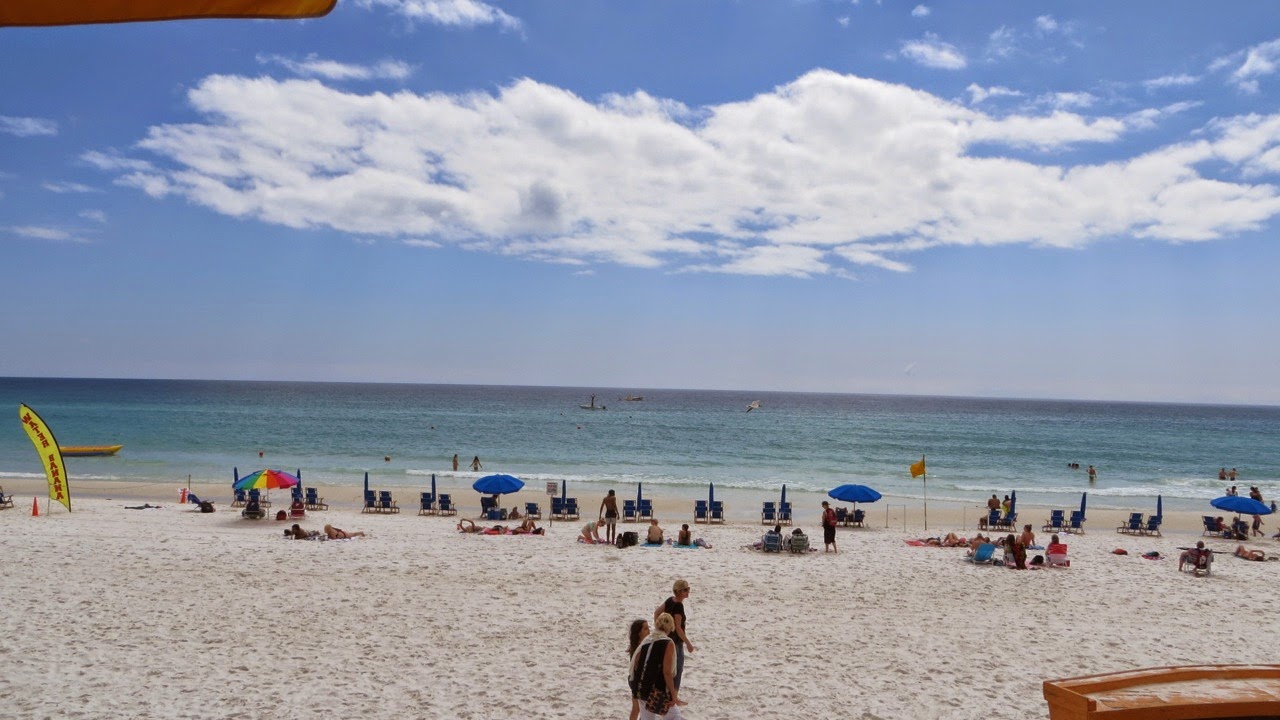
Destin, March 23
The beach in Destin is one of the few I’ve ever seen that can sell itself. It is way out on the Florida Panhandle toward Pensacola, surprisingly far from the rest of the state, and has clever marketing team at work for it that has come up with the name “the Emerald Coast.” That’s fair: the sea is a bright, lively green, especially in contrast with the perfectly white, powdery beach. It checks every box: the sea was even warm enough in March to go into it.

Beach economies tend to be so similar that the small distinctions become big differences. The infrastructure in Destin at first glance is very familiar: a strand of beach, fronted by hotels, with a strip just inland of eating and entertainment options (things to do in case it rains).

But Destin’s big advantage is that it is new. The hotel where we stayed was just across the beach road from the great ocean-fronting behemoths, and was so new it appears on Google Earth as a construction site. It is so new that no older, shabbier layers of development are present — the small motel-like places you find in older beach areas. The restaurants are new and mostly chain locations, which lack in local character what they make up in reliability. The alternative entertainments aren’t limited to just mini-golf places, but include some pretty rad-looking go-kart racetracks. The common denominator you’d find anywhere by the shore are those giant discount beach-supply emporiums, spaced on nearly every block which sell cheap beach towels with SEC team logos, novelty shot glasses, and spade-and-bucket sets for kids.

This sudden growth around the area shows just how efficient market capitalism is in talent-scouting. But this moment in capitalism isn’t much interested in long-term, sustainable development, but in developing resources and extracting as much money out as quickly as possible. So you see some big new hotels, and a lot of condos crowded wherever they’ll fit within walking distance of the beach. Most of them seem to be built on this generic ideal of fancy Southern living, with big galleries and porches and plenty of space for rocking chairs. They seem pleasant and comfortable, but blank.

All that newness is reflected in who you see there. We saw a lot of families with kids, a lot of late-model SUVs with stickers for soccer associations and the like in the parking lots. No battered sedans that look like they won’t make it back to where they came from, no rusting campers, nothing that a successful upper middle class family would be ashamed to climb into.

Word of this complacent bourgeois atmosphere has apparently gotten around. I read in the Pensacola newspaper an article about the Spring Break economy, which noted that college kids in the region had decided that Destin is boring as hell and to be avoided in favor of places like Panama City Beach. This was a relief to us, even if we did spy more than a few beer funnels on display at the beach shops, and a smattering of college kids on the beach who seemed pretty well-mannered. 

Unconvincing
It was interesting to see how these little groups of college kids interacted and spent their days. The girls would arrive in groups, content to lie in the sun listening to music on their headphones, occasionally taking photos of themselves. The boys would arrive a bit later (go-karts?), stand in little circles around a cooler of Bud Light and chat. Occasionally they’d take a break to throw around a football. Eventually, a group of the girls would take the initiative to go talk to the boys, they would throw the football around altogether, and there, temporary friendships are sealed, I suppose.

It looked a bit backwards from how these things happened when I was their age, but the elements were all the same. What has really changed — and so much so to be alarming — is how technology has butt in to even the simplest things. One night, we went to a restaurant on the main drive, one of those giant seafood shack places. As we waited for a table, an enormous group of college kids arrived and was seated at several long tables pushed together. This kind of group you expect to be loud and fun, but on the contrary, they were dead silent. Each of them settled in, whipped out their phone, and stared down, maybe occasionally showing something in a whisper to their neighbor. To be young, at the beach, with an abundance of people to flirt with, and they stare furiously at their phones imagining they were elsewhere. I fear how crippled these kids have become.

I think my phone stayed away most of the time we were there. When I wasn’t silently judging college kids in my near vicinity, I was busy just enjoying being outdoors in the warm air, rejoicing to be outside again and not freezing to death. Who could ask for more?

Our seaside fortification, Destin, Florida. March 22.

Thursday, April 9, 2015

On the Road (1): Getting there


Outside Lexington, Virginia
I’m often surprised and amused when I realize that I’ve seen more of eastern Europe than of the United States outside the little corner where I’m from and where I’ve spent most of my life. It’s something I’ve long wanted to correct, which is why my wife and I have long talked about setting off and spending some time driving around the rest of the country. We finally got around to it last month, inspired by an awful long winter up here cooped up, and a curiosity about what’s going on down South. 

Over ten days, we covered 3,434 miles and 13 states — not a bad tally to rack up in a 2005 Subaru Forester. Along the way we drove through the gamut of North American climate zones. We drove slowly through a substantial snowstorm in Pennsylvania, which obliged us to take the side roads through Amish country to avoid accident traffic on the interstate. We got through a huge downpour in the Florida Panhandle, and another weird flurry storm in Tennessee of all places. But the best parts were the hints of spring we found — perhaps fewer than we’d have liked, but they were there all the same.
March snow, Pennsylvania
We did a good job of taking breaks along the way, although we had a plan to stick to and couldn’t be as open-ended as a proper road trip demands. So alas, we drove right by the Shenandoah battlefields and right under Lookout Mountain without taking a look around. Those weren’t the only regrets.

The idea of the open road is a deep part of being an American. It began with the idea of pushing out, away from the coasts and the familiar and into a new world (I’ll gently set aside the obvious problem of who you might be pushing aside to do so, or who you might be bringing with you as coerced labor). It is an idea so strong it rebounded back on itself when our ancestors finally ran out of horizon to flee into.

I brought along with me my old, beat copy of On the Road, a book I’d valued since high school, when road trips were just a funny idea about a kind of thing I’d do when I was grown up and my own person. The book is so much about the kind of desperate wandering and searching that would land you an Adderall prescription nowadays, but beneath it is an acute awareness of the sadness and disappointment of life. That all these moments of travel and experience have a fleeting value, but don’t change much about human nature and what is mournful about it.

There was that idea in my head, but the real lessons of making such a trip have to be that there is just something grand about having your psychogeography broken down like that. Every now and then when you drive out of the driveway to the grocery store or work, you wonder what it would be like to just keep going. Where would you find yourself? what gas station off what road would you have to stop and look around? The great beauty of a road trip is that you begin to answer those questions.

I had that sense on the Thursday evening when we left, as I set the trip odometer to zero and imagined just what I would see over that dashboard over the next few days. The familiar old Hudson, the wide Susquehanna, the Smokey Mountains, the orderly farms of Tennessee, the heliosphere on the Knoxville skyline, the red earth of Alabama, the scrubby tropics of the Panhandle, the ocean mists of the Gulf of Mexico, the endless bayou on the way into New Orleans.
Near Andalusia, Alabama
You realize along the way that despite great variations — between slopes and rises, farms and cities, forests and fields — that it really is all connected. That the lines and labels of a map, or the views from Google Earth, aren’t the reality of what the land is.

And then you start thinking about all the people on it, and you see fewer and fewer license plates like your own on the highway. We were astonished at the number of crucifixes you see by the side of the road — both the giant constructions outside certain megachurches and the temporary, humble ones set up for Lent. I was amazed that for huge swathes of the trip the only things on the radio — the only things — were Christian radio (usually talking about abortion. What is your world like if you spend that much time thinking about it?) or “today’s country,” a reliable swirl of cultural references (cold beer, girls with southern accents, the value of weekends, overhearing a child praying, admiration for an elderly veteran, trucks). How can we make a a nation when we’re this far apart?
Chattanooga, Tennessee
For a northeastern travel makes you realize how alone we are. Living a paltry three hours from Times Square or Fenway Park makes you realize how compact this part of the world is, which is something I didn’t appreciate enough before.

This is the first installment of a few posts about the trip. Stay tuned!

The sea, Destin, Florida

Wednesday, October 8, 2014

SF: North Beach


No matter how hard I try to repackage it, my idea of San Francisco is permanently peopled and shaped by the Beat Generation. I know well that the place wasn't discovered by Kerouac and Cassady driving over the Bay Bridge, like a pair of irresponsible East Coast Columbuses. I know that California has welcomed generations of vagrants, crooks, and artists. But with any idea, you have to come in somewhere. And this is how I arrived.

I didn't make it to City Lights until my last day in the city, but there was certainly no way I would miss it. The legendary bookstore and publishing house founded by Lawrence Ferlinghetti has been on my mind for decades now — at least since 1989, when my freshman English teacher came to class one afternoon with a beret and bongoes and read Ferlinghetti's poems to us. Despite the Maynard G. Krebs props, Mr. Cook seemed to love and respect the work, which unlike everything else we read in the course, was alive. He told us that Ferlinghetti was still alive, and still had this bookstore in San Francisco, and you could still probably find him there. Wearing a beret, no doubt. To a kid still stuck in a small New England milltown worldview, that was an amazing concept.

When I made it to the store the night before we left, the sun was gone and it was drizzling. Before heading in I crossed "Kerouac Alley" to visit Vesuvio, the charming little dive where the boys did some of their famous drinking. It was just after work, the bar was pretty crowded. There were two groups of what were obviously tourists on some kind of literary pub crawl, filling the big tables and looking around while making slight small talk to each other. I squeezed up to the bar, between two groups of office women talking earnestly about their days at work. Way off in the corner, where the bar met the wall, there was a young man in a button-down shirt and glasses reading a giant book open in front of him. It could have been me, but I'm the kind of loner at bars who pulls out a notebook and starts scribbling all the time.

I like the place very much, even though it was crowded and loud, and managed to have installed gigantic plasma tvs that were showing sports. That, ironically, is one of the only things I remember about the first time I arrived at Vesuvio in 2004, when I watched some of the Athens Olympics there.

Back over to City Lights, which is so much smaller and quainter and less crowded than I expected. To my surprise, the big event seemed to be an anniversary run of Frank O'Hara's Lunch Poems, published by City Lights 50 years ago. It had a fancy new edition in bright blue and orange, and it included in the back reproductions of the correspondence between O'Hara and Ferlinghetti. I sat on a stool upstairs and read the whole thing, and felt perfectly at home. Despite the sheer amount of time I've spent in them, many kinds of bookstores feel alien to me — except, oddly, used bookstores which have a kind of down market charm that makes me think that time has vanished.

City Lights has an astonishing poetry section: full and broad and evangelical in the way it welcomes you and practically admonishes you to stay and have your mind opened a little. "Sit down and read something!" the sign commands. There are photos of Mayakovsky and Corso on the walls (and Yevtushenko, alas. No one's perfect). It is one of those places that remind you that poetry is important and matters, and isn't necessarily as frippy and dispensable as daily life can lead you to believe. It is a kind of temple to remind you of why poetry is important to you, and I dearly wish there were more places like it around.

I learned from a few other books about the lives the gang led in San Francisco, and the realization that Allen Ginsburg wrote "Howl" in an apartment on Pine Street, which is just behind the place where we were staying on Bush Street. That the Moloch he wrote about, the red-eyed monster in the smoke and mist, was the Sir Francis Drake Hotel on Powell Street that we'd walked past dozens of times already. That the hum of the cable car line in the street was the rhythm of that second canto of the poem.

It was a very literary block. From our window we could see the alley, where I key event in The Maltese Falcon happened (Dashiell Hammett Lane was right next to us). A plaque a few buildings away revealed that Robert Louis Stevenson had lived there for a little while. But the revelation about "Howl" was really amazing to me. I had always imagined it as a great New York poem — the references to Harlem and Rockland. Putting it there on that block, in that very specific location opened it up for me. A stew of very specific images and sounds had been born, something that nearly achieved the level of the universal. This poem that I read one afternoon in my high school library before baseball practice, shortly after Mr. Cook's performance. When I remembered those strange, long lines, those explicit bits that embarrassed me, the idea of freedom and space and future that poetry has in its guts.


Tuesday, September 30, 2014

SF: Haight Ashbury

Broken Clock, August 2014
With a few hours on my own, I took a walk around Haight Ashbury to see what's left of this place that has such a large presence in our idea of counterculture. What stuck out about the place to me the most, the idea that I couldn't shake no matter how much I tried, was the amount of bad energy that swirls around the place.

A big part of that is in how the place still attracts and draws people who are looking to live in a certain way. Walking up past Buena Vista Park, you smell marijuana and you can't figure out from where. No big problem there, but you see the folks huddled around — there was a fierce, cold drizzle bearing down from the ocean. I was a bit stunned by how young many of them seemed. They are living some kind of fantasy of self-realization, but the reality looks more like a very sad joke.

This particular vibe around the neighborhood is hardly new. Joan Didion explored it at great length in her magazine piece "Slouching Toward Bethlehem" about the human cost of the "Summer of Love." For awhile I thought her tone and focus was excessively negative — that she was more interested in making fun of Jerry Garcia than hearing his music. But it's really there. The way she identifies in the inarticulate longings and hopes that characterize the people that went there and tried to make a life, and how that is a product of our consumer culture that has only gotten much, much worse in the past few decades.

There was, of course, something self-indulgent and self-absorbed about the whole thing. It is one of those things in the art and music of the period that I try to ignore. Though sometimes, it just pops up. I happened to come across an article quoting Garcia and the Dead upon hearing of the death of their friend Janis Joplin in 1970. There was no talk about the tragic, avoidable, and stupid loss of a brilliant talent. It was all about how that was her trip, man, and ain't nothing nobody could do about it. It sounded monstrous.

There is a weird, complacent danger of "finding your tribe." On Haight Street I spent some time at an anarchist bookstore, and it was a very warm and pleasant place for me. All the books were interesting, all the t-shirts proclaimed sentiments I would proclaim were I the type to proclaim things on my clothing. There was a whole rack of small press pamphlets and broadsides — a scene that appeared more vibrant than their minuscule circulations would suggest. I bought a book by Viktor Serge and was happy to be a part of the solution.

There was a young man at the counter chatting with the fellow that worked there —volunteered there, rather. He was gushing, asking about writers and books and where he could find them. The guy at the register had walrus-y sideburns and was glad to talk. The young man explained that he was passing through town — just traveling from one place to another, you know? But he'd definitely be back. The walrus-y fellow piously declared that the Haight was the only part of the city worth anything anymore.

Which based on the rest of my wandering around the neighborhood is a pretty wild assertion to make. If he said Berkeley, or Oakland, I'd buy it, but the rest of the area seemed warped and frozen in place, but in a preposterous way.

I'm fascinated by what Haight Ashbury means to certain generations. I feel very much for what drove all those kids there in 1967, but even more so for those that felt the pull but stayed put. Much has been made of the way that the "Summer of Love" was inflated, exploited, condemned, and killed by mass media. But the message of it must have been very powerful for young people trapped in sad cloudy milltowns, or the military, or any of the less exciting parts of the country. It must have been very important to know in the back of your mind that there was the idea of escape — as you dragged yourself through school, or a tour in the Army, or a shift at the factory so you could pay your suddenly adult-looking stack of bills for your new family. Sometimes ideas have power.

So what would that person who stayed make of what the Haight has become. It is part tourist trap, part magnet for purposefully lost children. It is a regular procession of shops selling everything tie-dyed, with water pipes and mood rings and vintage Quicksilver Messenger Service posters. But even that message, its own history, is getting a few whacks in strange directions. The sonic firmament is shifting — lots of Grateful Dead, of course. Janis Joplin remains big, and there is a definite presence of Jefferson Airplane, and Jimi Hendrix. The Beatles are there ex officio. But the plot starts to get confused with Bob Marley — now we are interpreting the spirit a bit more broadly. But it goes wildly off with Led Zeppelin. This story belongs to no one anymore.

And progress and capitalism diligently, relentlessly clomps on. Haight Ashbury is in San Francisco, and markets wait for no man in the United States. I strayed off Haight onto Ashbury Street to find the Grateful Dead house, the cheap dilapidated rowhouse where the whole band and its various hangers-on and friends lived in a brief kind of communal harmony (for a little while at least). It was easy to find the house, thanks to the impromptu sidewalk graffiti featuring Dead iconography (and Bob Marley, for whatever reason). But the house itself is just another amazing old Frisco Victorian. With huge windows and fresh paint and plenty of urban appeal. When you walk off Haight Street today, you are transported in ways Owsley and the Diggers could have never imagined — you are dropped right back into some of the most expensive real estate on earth.


Haight Ashbury, August 2014

Tuesday, September 23, 2014

SF: Unlikely Geography

Bay, bridge, and Pacific fog
The first thing you notice is the weather. If you land in Oakland you see it before you feel it: the great Pacific fog hanging over the city ready to engulf it. In August, it is chill, fogs, and wind, of different degrees and variety depending on where you are, but always there.

The Chronicle, in its weather boxes, absurdly lists the day's high temperatures as between 62 and 90 degrees. Every day.

Given the unlikely geography of San Francisco it is amazing there is a city there at all. At Mission Delores, the first Spanish settlement in the area, there are prints of what the land looked like when Europeans first appeared. 
The peninsula was all hills and dunes and weird strange weather. And no one even found until hilariously late because the Golden Gate was hidden by fog so often. Most of the local Native Americans shunned the place, preferring to spend their time in any number of friendlier locations around the Bay.

It takes a lot of collective enterprise to pull of a city in a place like that, perhaps not on the scale of Venice or Amsterdam or St. Petersburg, but the same idea. That's why the Golden Gate Bridge is such an apt symbol for the city. It is a thing of astonishing scale — about 1.7 miles long, with towers that soar to 746 feet. It was designed and built in the very teeth of the Depression, when the global economy had completely cratered, almost as a deliberate act of will. And even more so, why was it built? It connects the city to... Marin County? Was a crowded ferry to Sausalito really such a burden? If you think about it, it is hard to imagine a national project that was less necessary.

But when you see it, you forget about all that. It's like the space program in a sense. One of those things societies do just to remind themselves of their potential as a species.

Wednesday, September 17, 2014

A series of words about San Francisco

Powell Street
On the premise that no travel should be wasted by not writing about it, I'm going to post a few small pieces about what we saw and did on our trip to the City by the Bay last month. It's taken me a while to get around to it — probably because I can't seem to get this fall underway, because the summer felt so short. But now it's back to work.

Thursday, July 31, 2014

Tuesday, July 29, 2014

When Brooklyn is not enough

There was a time when going to Pearl Street was a big part of my summers. During my summers back home when I was in college, I'd usually make it a few times to the Northampton night club, which was a part of the indie rock circuit at the time. This summer, with a month to myself while the wife and daughter are visiting relatives, I kept a close eye on the listings. I noticed last week a show of a few bands from Brooklyn, so I drove down for dinner and to see what the kids are up to today.

I think the last time I went to Pearl Street it was to see the Swedish band The Soundtrack of Our Lives, which I and maybe ten other people seemed to enjoy. The club was the same as I remembered — filthy and dark, but not as smelly as I remembered thanks to the smoking ban. The security was absurd, the drinks expensive, the sound wretched — all the same.

Their schedule this summer has, more or less, sucked. Ordinarily I wouldn't be super excited to see a bunch bands from Brooklyn, but it was honestly the only thing that remotely caught my attention. And I don't really know why — maybe because I like MGMT, and one of the bands were friends with them in college. Maybe because New York still might mean something as a creative hub. But it was really weird how each of the bands frequently told us they were from Brooklyn (not New York, Brooklyn), as if that was a desperately critical piece of information we had to drill into our heads or all would be lost. I would love to know what these guys think Brooklyn means out here in the sticks, but I bet it's not what they think it means.

The first band was an outfit called Total Slacker, which to my amusement/horror is a 90s nostalgia act. That is, their bassist wore a t-shirt with Fox Mulder's "I Want to Believe" poster on it. Lead guitarist/singer Tucker Rountree borrows a bit from Kurt Cobain's look and Thurston Moore's voice. I enjoyed their set — knots of noise and feedback, plenty of drones and grooves. I actually sort of liked them, but I never thought the culture of my youth would be a retro throwback for the young'uns. At least not yet.

It is a much richer experience to see bands in small, out-of-the-way, divey joints like Pearl Street. You see a lot just waiting around — who's fighting with their chick, who needs a smoke, who is drinking maybe too much before the show. There are these little moments — Rountree walked right past on his way to the stage, and we made eye contact for a second, nodded and said "hey." This sort of matters, I realized this is a guy who is aware that he's doing something that involves other people. That small human connection makes you root for them. I still have a soft spot for Jen Trynin based on that one time I saw her at Pearl Street in 1994.


The second act up was Junior Prom, a pair of hilariously photogenic young men with an array of synthesizers that do this hopped up disco-skiffle thing. I admired their energy, which is the apparent result of the naive hope and optimism that comes between your debut EP and first LP. Everything is looking up for these guys — or at least to these guys. They might make it, or they might disappear. I can't predict which.

Then we can to the main act, a group called Bear Hands (from Brooklyn, no one can stress this enough). I almost didn't go just because of their name alone (speaking of which, geezus, these were the worst band names I've ever seen in my life). They've been around for a few years, and are touring on their second album. They have a couple of videos on YouTube — but these days making a pro-looking video is just about the easiest thing you can do. But there's very little buzz about them in the usual places.

The kindest way to describe their set is to say that it didn't really connect. It starts with Dylan Rau, their singer, who keeps his eyes firmly shut and sings in a mannered kind of yelp that feels like a particularly insolent kind of karaoke. It was clear they were tired; they've been touring all year, and have a lot more ahead of them in the next few months.

It wasn't at all what I expected. Based on their albums and videos, I figured they would realize that their hook-heavy songs really need a bit of Junior Prom's energy to come across. But it wasn't there. They opened with "Agora," a decent song that somewhat thoughtfully deals with agoraphobia. But the cheerlessly professional version they offered was almost sad. The same thing for their other single, "Giants," which is really a downer they way they played it.

They played dutifully, then said goodnight. I don't have any idea what becomes of this band. Maybe they get worked into an episode of Girls. Maybe they land a VW commercial. As it stands, if your capsule bio says more about where you are from and other bands you sound like, you probably aren't thriving. I don't know what they can do to change it, and I suspect they don't know either.

Happens to us all, kids. But God, just shut up about Brooklyn already.

Friday, July 18, 2014

A stupid game

I've been slowly getting through Orlando Figes' recent book about the Crimean War, seeing how relevant that part of the world has become again. What strikes you first is just how much of an anomaly the Soviet experience was, and how quickly Russia jumped back to earlier times. To when Russia was a socially retarded, violent, paranoid feudal state, with a ruthless top-down power structure, a complicit national faith with delusions of being the next Roman empire, and a swaggering sense of racial superiority.

It's often tempting to leave them alone and deal with them as best we can, but what happened to the Malaysian Airlines flight yesterday shows what happens when this bullshit spills over. 298 people who had nothing to do with this stupid little farce in eastern Ukraine were blown out of the sky, and setting aside all the usual caveats about what we know and don't know, the moral dimension is very clear. To Putin's power structure this is all a big f-ing game. It's jaw-dropping how creative the bootlicking Russian media has been happy to publicly fantasize about what might have happened.

The news yesterday was a huge shock to those of us who have continued to follow the news from Ukraine closely. It has felt for awhile that the situation was beginning to sort itself out. That with Crimea firmly in hand, Putin wasn't all that interested in a huge flare-up in the east. And the quiet support from Moscow was worrying the separatists enough that they began whining about being abandoned. And the world was beginning to see what was happening — that these separatists were a small, violent minority made up of the usual unemployable lot of track-suit wearing losers you find getting drunk in housing projects all over Eastern Europe.

I hope the world can maintain a sense of outrage about this, and that there will be real consequences for this regime. But I don't expect that will happen. The history of civilian aviation is full of moments like this — when airline passengers have been murdered by misunderstanding — and nothing really changed.

Putin and his crew don't care what the world thinks. Holy Russia is beyond reproach, and all that matters is the integrity of the internal "power vertical." And worse, as David Remnick pointed out on the New Yorker website: "Vladimir Putin, acting out of resentment and fury toward the West and the leaders in Kiev, has fanned a kind of prolonged political frenzy, both in Russia and among his confederates in Ukraine, that serves his immediate political needs but that he can no longer easily calibrate and control."

Wednesday, May 28, 2014

A Day at the Space Center; or, Lamenting our Lost Space Age

Playground of the Musks: although historic Launchpad 39-A looks empty and still now, SpaceX has the commercial lease to launch from there in the future.
Perhaps I'm paranoid, but it felt like there was something suspicious in the way our tour guide at Kennedy Space Center kept talking about Elon Musk. In my last post, I gushed about how much I enjoyed our visit to the center, but hearing so many times about how this South African billionaire equity dude was a "visionary" and the future of our space program seemed inappropriate.

Every museum is a window into the time and place where it exists. So, while the American Museum of Natural History is a case study in the "benefits" and contradictions of modern American plutocracy, the lesson at KSC seems to be the ways Americans are avoiding the subject of how wealth polarization is an integral part of our national decline, and how it is a process we refuse to acknowledge, let alone understand or attempt to address.

Everything at the space center is a celebration of a specific moment in American history. That period of a few decades — which is emphatically now in the past — when we had a sense of common purpose, and the ingenuity and motivation to do amazing things. We look back at what we did with awe and pride, but when we turn to the present and the future, we have… well, Elon Musk.

We are now at a very low point of the history of our space program — though you hate to say "the lowest" point because it certainly could get worse. We have to rely on the Russian's to get to and from space. The Chinese have the kind of "let's show the world who's boss" gumption that we had 50 years ago. And the void is filled with Musk's SpaceX, and other companies like Boeing, Lockheed, and Sierra Nevada. Each of these is a perfect representation of late-stage capitalism: entities designed to create value for shareholders, not to produce a profit while doing cool and useful things for all of us.

These companies alone are what makes KSC what it always has been — a working spaceport and the 20th century equivalent of Colonial Williamsburg. That's important to the tour guides who now talk about CEOs with the same kind of awe we once reserved for John Glenn and Neil Armstrong, and for the entire regional economy, which with zero irony calls itself the "Space Coast." Guys like Musk are the only viable future in sight — a future that is also seductively exciting and profitable as well.

This is the great fever dream of privatization — the twisted logic that things that ought to be free of the greed and callousness of the market should be handled by anything other than the government. It is a dream shared by the stunted adolescent boys who think Ayn Rand is a great thinker, and the centrist Democrats who so admire their own genius and virtue that of course they should get fabulously rich solving the world's problems.

But to have these thoughts at Kennedy is an insult to the memory of what Americans did there. You see very clearly, now that nothing is really being launched from all those disused pads spread all over, that the glory days are well past. That the practical reality of what SpaceX and the others propose (not the fanciful p.r. chatter about going to Mars), is merely redoing what we figured out how to do 40 years ago.

The heroic Space Age celebrated at KSC is the product of a stream of circumstances in the post-War years, when most of the world had blown itself to rubble and the U.S. completely remade the global economic system to our advantage. Back in the day when we had the will to dream big, the willingness to pay our f--king taxes so we could have nice things, and the trust that collective action could do things like send us to the moon. When we had a rival in the USSR that pushed us stay on track.

But that's all well over. We've turned into a third-rate plutocracy where NASA has to beg hillbilly congressmen who believe in the literal truth of fairy tales from the Book of Genesis for change from the sofa.

Wednesday, May 14, 2014

Space is gonna do me good

The early ones
As we drove across Merritt Island, which in addition to being the home of the Kennedy Space Center is also a giant nature preserve, we kept count of the alligators we saw in the drainage trench beside the road. The idea of wild alligators is a trippy one for northerners, but Florida is like that in every single way. You get to have fun down there with sharp contrasts — palm trees all over, egrets and herons hanging around, air temperature that isn't too cold. The land is lush, packed, and green, and it is a bit jarring to think that it is from there that humans blasted off to explore the cold vastness of space.

We went to Cape Canaveral on our last trip to Florida with Mila and my mom, and it was something I'd been looking forward to for years. That place is deeply burned in my memory, because I must have been about seven years old myself when I went there. That whole trip is pretty much welded into my consciousness — right from the flight on Eastern airlines, which was quite an odyssey to me. About the space center I remember lots of open spaces, and a kind of bright sunlight that made everything glow in a weird way. I remember the sandy soil and sharp prickly grass, and the rockets lying around at all angles around like broken pipes.

That trip we also had a chance to watch a space shuttle launch. It was a few days later, and it was from Daytona Beach up the coast, but I remember being told about it and being very excited. I was a bit disappointed when the thing itself was just watching a long matchstick arc into the sky over the ocean, along with a distant rumble. I was expecting something more akin to what you saw on t.v., so I was a bit disappointed. I tried hard to remember that feeling as I got all excited explaining things to Mila, to not take her occassional indifference personally.

I realized the challenge right off the bat, when we signed up for a bus tour of the vast facility, driving out to the old launch pads by the sea, which at this point are really not much more than disused industrial sites. The idea of what happened there requires a massive act of imagination, and I'm not sure if I convinced her it was worth her time.

She bravely got through the experience, but I was fascinated throughout. NASA has been the repository for so many dreams of what it means to be on the technological cutting edge that seeing the actual buildings where it happens is very weird. At the center of the base is a non-descript cluster of buildings called the "Industrial Area," which features the center's headquarters and its operations building. That's the one where astronauts would train and be quarantined just before their missions, the one they walked out of to the bus for the drive to the pad. The buildings are almost comically common, like some backwater office complex. And it is hard to believe that men and women could plan and execute the launch of people to the moon and back from from a plain building make of cinder blocks, with air conditioners droning in the windows, and blinds keeping out the intense afternoon sun. With a few alligators lolling about not too far away.

And there are the hilarious contrasts down there that you can't really appreciate. The Vehicle Assembly Building is one of the most interesting structures on earth — the world's largest single-story facility, with nearly the most interior volume on earth, and at 526 feet high believed to be the tallest building outside a city. That last fact is what grabs you — you stare at the place and realize there is something up with it, but it feels like some kind of optical illusion because there is no context whatsoever. 


Bigger than it looks
The KSC experience really takes off with the exhibits, which are slick but not simple, and dump a lot of information at you in a flashy and fun way. There's lots of engineering and aviation science, and well-done history. You get a real sense of the enormous leap between the early Mercury-Redstone rockets of the Mercury program and the Saturn V rockets of the Apollo program just a few years later — the jump from modified ICBMs with people strapped to the top designed to throw you off the face of the earth, and actual spacecraft designed to throw you out of earth's orbit. They do an amazing job of presenting just how amazing and strange the Apollo program was — that we really haven't seen or done anything like it before or since.

If there is a disappointing angle to all this, it has to be the coverage of the Mercury and Gemini programs, which are assigned to their own pavilion near the entrance. The exhibit feels campy in a way that disrespects what these these guys in aluminum foil suits with their buzzcuts and cool expressions represented.

The new big thing at KSC is the space shuttle "Atlantis," which has been housed in its own brand new pavilion since last year. The shuttle program gets the respect it deserves, which had definitely faded in the years of routine missions to haul up satellites and space station modules. The exhibit makes you realize what a technical achievement the program was, and that there was never anything routine about what they were doing.

As you can see, the visit brought out something unusually boyish in me, and I'm aware how silly it seems. Earlier this spring, I took Mila to hear two astronauts speak at MCLA, and there was something about their demeanor and the way they spoke that was timelessly earnest. It was in the way they rattled off statistics about mission specs, payloads, and the mechanics of keeping yourself alive in an absurdly hostile environment. And at other times they became awkwardly poetic as they described watching whole continents pass under their eyes, or about the giddy sense of purpose that comes with being able to see the whole earth as a frail little ball hanging in vast black nothing.

KSC has created a space that allows you to appreciate all that, and frees you from the obligation to be an eye-rolling teenager. For me, I realized that if you look at it with a squint, the entire space program doesn't have to have been about what I cynically assumed it was. Not a public relations branch of the military/industrial complex, nor a heroic advance in the science of understanding our universe, nor about practical stuff like better communications and weather satellites. In a sense, it is a great big poetry program designed to make us wonder in a secular, humanist, nondenominational way about what we are and what we could be. About the great things we can do when we inspire one another, and share the burden of designing our technology and paying our bills. To feel pride and astonishment about what we did in the past, and to think constructively about our future.

Jeez, that's corny. They must've put something in the water.

Wednesday, May 7, 2014

The stones of San Juan


The way these things work, I didn't get to see a lot of San Juan — let alone Puerto Rico — when we passed through last month. We spent most of our day climbing around the fortress at San Cristobal. For fans of fortifications, like me, this is plenty fun — even if I had to play up the pirate attack angle to keep my daughter's attention. Here's are the coastal defenses of the old city, looking over toward El Morro and the entrance to the bay.

Saturday, April 19, 2014

Around the Homosassa River


Had a few weeks of heavy work (eh, freelancing), and am now down south in Florida for a visit. Today spent the afternoon on an airboat poking around the Homosassa River, seeing the inlets and islands out around that patch of the Gulf Coast.  

Tuesday, March 18, 2014

Russia as it was, as it will be

I've been looking at that last post above, and how much things have changed since then. It's been an amazing, and profoundly depressing few weeks for those of us who have an interest in Russia and its future. I've been paralyzed over how to begin to make sense of all this here, my attitude and fears about what's happening keep changing — becoming reliably more bleak.

There has been a lot of interesting commentary about all this. I think Julia Ioffe at the New Republic did the best job of capturing just how sad it has been to watch from afar this descent into madness:
"Westerners rightly know Russia as a font of absurdity, but lately, it’s been hard to keep up: I’ve been trying to write this post for a solid week now, and have been constantly derailed by the increasingly bizarre and worrying developments coming from the Trans-Eurasian Development Belt."
She ticks off some of the nonsense. The absurdities issued by Kremlin flunkeys in the Duma, the belligerent posturing of the neckless tough guys that dominate the Russian conversation, the inability to discern just where all this ends.
"Here’s what’s scary about this: this is all being done, according to various reports, without any consultation with anyone outside Putin’s shrinking inner circle of old KGB spooks. The economic elites most likely to suffer from a plummeting ruble and sanctions have been shut out of the decision-making process. This is all about intangibles, the things that reason can't hook, the things impervious to logic and reasoning and even the cynical algebra of geopolitical interests. This is about pride and values and the Trans-Eurasian Development Belt. 
And, yes, all of this is familiar and increasingly terrifying, but to whom? To you and me and an increasingly besieged island of Moscow liberals? Because, terrifyingly, familiarly, all of this works. The method has been tried many times, and it is true: Putin’s approval ratings have grown to their highest level in three years."
For 15 years, Putin in plain sight wrote the blueprint and assembled an apparatus for a new kind of autocratic oppression. And now we're watching it click and whir into life.