
Showing posts with label buildings. Show all posts
Showing posts with label buildings. Show all posts
Wednesday, May 7, 2014
The stones of San Juan


Wednesday, December 18, 2013
The new ICA in Boston
 |
| The new ICA on the waterfront, Nov. 22, 2013 |
I had once visited the ICA's former home, in a converted firehouse in Back Bay which it had quite clearly outgrown. But that it took so long to get its new facility says a lot about the politics of art funding around here. In the 80s and 90s, while MoCA was struggling through its long gestation, no institution complained louder and longer than ICA. The couldn't believe the state would spend tens of millions of dollars on a brand new contemporary art museum in the middle of nowhere.
Maybe they had a point, but since I live here in Berkshire County and not in Boston, I can't give it too much thought. Boston has a lot of cultural offerings and economic opportunities. We get the short end of the stick often enough — there are real reasons why in many ways we feel closer to New York than to Boston.
The new ICA, like MoCA, was built at at time when museums must be considered more than simply places to store art. Today, they have to be part of a broader economic development scheme, in their case an effort to bring something to the desolate stretch of waterfront between the Moakley Federal Courthouse and the cavernous new convention behemoth. It seems like that project is coming along in a rather fitful way. Walking to the are from South Station, it feels like lots of parking lots and glass towers, not like a neighborhood in any meaningful way. In a city with such a deep history, and with so many vibrant and ancient communities all around, the ICA finds itself anchoring the one part of Boston with no personality whatsoever.
The building itself is quite an achievement, in a very showy way. Designed by Diller Scofidio + Renfro, it shows off its engineering skill and cutting edginess every way it can, through its contours of glass, steel, and concrete. The effect can be disorienting — it feels to me like it was built upside down. Many of its enthusiasts talk about how open it is, how it interacts with the water in front of it. All true, I guess, but you might also note how noisy it is, and how many of the spaces don't make much sense. One of the weirder features is something called the "mediatheque," a long narrow pod emerging from the belly of the building which is filled with rows and rows of computers, and where visitors are invited to relax and watch videos and other content relative to the exhibits. That's alright, but scourge of concrete building, I couldn't help but notice the giant crack in one of the upper steps.
The building got me thinking about architecture in Boston, and led me to a strange realization: the much-maligned Boston City Hall might be the last truly brave and interesting thing built in that city. Partly that's for the simple reason that it came from a distinct school of thought, and had the guts to stick to it. Whatever would replace it — and the new mayor has already said he's open to the idea — would be timid, flashy, and as brave as an investment banker's new BMW. You only have to look around the Financial District from across the Fort Point Channel to see how dumb and bland things have gotten. One mediocre high-rise with a cheap gimmick feature next to another. And don't even get me started on the TD Bank Garden.
These are building that just do their job. And the job of the new ICA is to shout, "Look at the neat arty thing sitting over here!" And the exhibits on display didn't really convince me that any serious path-breaking work is going on. A retrospective of the work of Amy Sillman, which was entertaining, along with an obvious show of new work considering the boundaries of painting, and the work of a photographer who takes unflinching images of postindustrial society. In other words, nothing really surprising.
There is so much awesome stuff in Boston. A day at the Museum of Fine Art is as great an art experience as you can have in America. On my last trip, I paid my first visit to the Isabella Steward Gardner Museum, which boasts an astonishing collection hiding in a quirky setting (perhaps too quirky at times, but that's just me). Boston also has an amazing aquarium, a stupendous science museum, and a world class symphony. But contemporary art remains an afterthought.
Friday, October 4, 2013
Anselm Kiefer arrives at Mass MoCA
 |
| 'Narrow Are the Vessels' |
I went to visit the new space when it opened late last month. The building, which is near the Hadley Overpass on a previously unused portion of the campus, is as grand and severe as Kiefer's work. It is pitch-perfect for the works on display, and my only complaint is that it is much smaller than I would have hoped (only three works, really, but each of them is a doozy).
It begins with Narrow Are the Vessels, which MoCA-goers will remember had been in the main gallery for some time awhile back. The piece is a pile of long slabs on concrete, with rusty rebar jutting out in a menacing way, and crumbling bits of cement scattered on the floor. It looks like the aftermath of a bombing or an earthquake, the product of some sort of violence. But you realize after a few minutes that you've never seen concrete with such graceful curves and undulations, and wonder what this might have been before it became wreckage.
 |
| One of 30 paintings on display |
Within a gallery inside the gallery is the 30 painting series Velmir Chlebnikov, a tribute to the "Russian poet and futurist who created complex analytical systems based on esoteric mathematical calculations meant to reveal vast paradoxes in logic and in the progression of history." In particular, it is about famous sea battle through the years, and seeing them together evokes the cycles of tides and weather and water that will haunt you if you go to the sea in the right frame of mind. Each canvas is encrusted with pain, and suggests its subject the way J.M.W. Turner's seascapes do. They speak of dark nights on a moonlight sea, the silent frightening depths, the fog, the lonely strand and scattered wreckage washed ashore.
Each of the pieces is about the patterns that emerge from chaos, about the grace and beauty of these moments in the present, and the ways they harden into memory and history. It is lyrical and human, and not as cold and distant as it seems at first. It's a perfect addition.
Each of the pieces is about the patterns that emerge from chaos, about the grace and beauty of these moments in the present, and the ways they harden into memory and history. It is lyrical and human, and not as cold and distant as it seems at first. It's a perfect addition.
Thursday, May 23, 2013
The Tropicana Field Experience

Last week, on a quick trip to Florida, I had a chance to catch the Sox down there, and seeing a game there was just as weird as I always imagined it would be.
The strangeness begins on the interstate, as you head into St. Petersburg from Tampa and the stadium appears before you, like some kind of giant, lopsided wart. It is near the highway, which is good I guess, but apparently everyone is convinced it is too far from most of the population of the Tampa Bay region, which is bad. Its neighborhood feels very lonely — in one of those marginal neighborhoods Sun Belt cities seem to have with undesirable and possibly empty office buildings, lots of parking lots, multi-lane boulevards, and no sign of human life outside of vehicles except the guys waving stadium traffic to the lots.
As is critical in that part of the country, there is lots of parking. And since the weather is always nice, there was some actual tailgating going on when we arrived. But even for a parking lot, it's pretty bland, save for the tall palm trees and the long mosaic on the pavement that leads through the lots to the stadium entrance from... nowhere.

There is a main entrance rotunda, which bizarrely lets you into the outfield seats (and which, more bizarrely, the team claims was inspired by Ebbets Field). The inside tunnels are fairly spacious, with creatively packed with ways to spend money. But the walls are all painted cinder block, and there is something temporary about it all. It feels like one of those semi-permanent structures you find at fairgrounds.


We sat in the 200-level, just beside press box on the third base side. Since it is a rare case of a baseball-only indoor stadium, it feels about the right size. And the sight lines for baseball were great. But it was very hard to put out of your mind how strange it is to be watching a game indoors when the weather outside is so nice. Sure, there are lots of showers and storms in the summer, but it is still hard to make peace with having a roof over your head for baseball. Or the massive air conditioning ducts lining the upper level. The Trop makes it worse by having such a strange roof, with its concentric circles of catwalks that have occasionally gotten in the way of the game. I have no idea how fielders play there, because just watching, I lost every fly ball that went up.

I imagine it is a little easier for Rays fans live with the place now that the team has some history to build on. All over you see lots of photos from those encouraging recent years, but I fear that winning hasn't translated into any greater passion for the team. Attendance was very poor when I was there, and there was a very strong presence of Sox fans. By that, I mean close to half the obvious fans I saw were supporting the visitors. My section got very loud when Stephen Drew's grand slam blew the game open in the third inning.

There's been a lot of chatter down there about getting a new ballpark, preferably somewhere more central in Tampa, with a retractable roof. But thanks to the fiasco of the Marlins new stadium down in Miami, the team probably can't count on much taxpayer help. I think the Trop will be around for awhile. And since tickets are affordable, the place is comfortable, and the team is decent, that isn't a disaster.
Friday, March 29, 2013
The Towers of New York
 |
| 'One57,' through the trees of a Central Park playground |
But what stood out to me the most on our trip last weekend was this new obnoxious fad for incredibly high glass needles poking up all around Midtown. One in particular seems to be deliberately giving the finger to the rest of the city — the risible thing called "One57," where full-floor penthouses go for $90 million, and owners will have the cheap thrill of looking down on the Empire State Building, and pretty much everything else.
Architecture reflects its time, and this skinny shard says quite a lot about overheated, plutocratic New York, with its top-heavy concentration of unearned wealth and rentier values. It is not a place where anyone will live, it will only be owned. The assembled neighborhood of billionaire plutocrats — Russian oligarchs, Middle Eastern oil royals, corrupt Chinese Communist officials, our own Wall Street "geniuses" — own too much to really settle down with any single thing, person, or space. One57 will remain unloved, wrapped in its cold self-absorption, a monument to the eternal value of selfishness. As an aesthetic object, it offers nothing to anyone who can't afford it. In the old days, the wealthy and powerful cared about creating stunning and beautiful structures. Of course it was for themselves foremost, but at least we peons and serfs got to look at the outside.
In terms of design, I'm sure our overheated real estate market can fund architectural raves about this thing, but it is all as meaningless and cynical as any commercial copy. To me, this thing recalls nothing but the medieval Towers of Bologna. In the middle ages there was a fad among the wealthiest families in the city to build ridiculously tall brick towers. Perhaps they were originally intended as "defensive" structures, but as is ever the case with any self-styled Master of the Universe (no matter how small), it became a visually striking way of just showing off.
And of course, with time, most of them fell down.
 |
| The Assinelli Tower, one of the last of Bologna's famous medieval towers still standing (for now). |
Tuesday, June 5, 2012
Magyarország-Írország, at Puskás Ferenc Stadion
 |
| The view from Section 'E Jobb' |
Monday was warm, a bit hazy, and the air was heavy and damp. It was the kind of day that you knew would end in rain, but so many around here this year have been like that and nothing happened. So even as I checked out the Hungarian meteorological service's website, and watched on the radar feed the line of rain and lightning punching up along Balaton toward the capital, I remained hopeful.
Bus 75 goes from near my apartment over through Angyalföld, past Varosliget and ends all the way at the stadium. I waited to meet the friends I was going with outside the Stadium metro station. This was not only my first international football match, it was easily the highest level match I've ever seen. Heck, the first professional match I'd ever attended was only about a month ago. I was surprised at how diverse the crowd was ― always surprised to see girls at sports events. There were a good number of Ireland fans around, and everyone seemed in a good mood.
As we made our way around the Papp Sportsarena toward our entrance, which was clear across the other side from the station, the rain began. And it was a real summertime downpour. The kind of rain when you're soaked and can't see and have to wait under a tree for a few minutes. It was under that wall of water that we found our gate, had our bags searched, presented our soaked and crumbling tickets. This is the part in which I which I could have been paying attention, because we had to run across the field to the stadium to get under the eaves as fast as possible.
It is hard to imagine a more plain stadium design. It is a giant oval, laid north to south. The east end has a covered stand and boxes, and is where the benches and field entrances are. The west end is all business, row upon row, in two levels, of seats on a very slight slope. For our game ― and I imagine for most games for the past few decades ― only the lower level was open. The grace of the place's design is its simplicity — this is a space for packing in a mass of people to watch something at one time. It's charm, as it were, comes from its history, but that only goes so far.
 |
| Taking cover while waiting for the lightning to pass |
Our seats were on the north-west end, above the corner flag. We could see the entire field pretty well, but the main complaint was the sheer distance. With a track oval in the field as well, it felt like we were miles away. We weren't able to go down to our seats right away because of the flood, and almost everyone was crammed beneath the upper section, watching an astonishing amount of water come pouring from the upper level gutter into a storm drain. The game itself was delayed because there was still lightning in the area.
For the poetry of it, I'd defer to Keith Duggan's match report in Tuesday's Irish Times:
When it got underway, the rain went away and it was a good time. The fans were loud and engaged, and the game itself was pretty good. Even though it ended in a 0-0 draw, it was a pretty exciting, back-and-forth match, especially in the first half. The wave of substitutions in the second half gave the match a little bit of a disjointed feeling, but it certainly kept your interest.
I'd have liked to spend a little more time at the scene, but it was late when it wrapped up and we didn't want to get stuck in the crowd. You really feel how ancient and crumbling the place is when you leave at night after the event. You go from from the bright lights through the tunnel, and down the steps. You are aware of the hulking upper section over your head, but there are practically no lights. You see only shadows and concrete as you file down the steps, which end when you splash into a four-inch deep mud puddle at the bottom, and slosh your way through the swamped grass to the street.
The old Népstadion certainly has its history. But when a new stadium appears ― no doubt around when that other mythic public works project does ― I don't think it will be much missed.
For the poetry of it, I'd defer to Keith Duggan's match report in Tuesday's Irish Times:
Noon-day sunshine had given way to storm clouds by late afternoon and as the visiting fans began to appear on the metro lines, the sky over Budapest began to look almost Celtic: Moody and darkening.
As the teams warmed, the Hungarians chanted the odes which have been echoing around the stadium since Puskas was the dashing young matinee idol of the city and the Magyars were the jewel of continental football. The Irish responded with more familiar refrains.
Then, just as the players were leaving the field after their preliminary warm-up, the sky growled and lightning flashed, eclipsing the floodlights, and a spectacular rainstorm swept through through the stadium, tap-dancing across the running track, ruining summer shirts and dresses and leaving the players huddled in their dressing rooms.
When it got underway, the rain went away and it was a good time. The fans were loud and engaged, and the game itself was pretty good. Even though it ended in a 0-0 draw, it was a pretty exciting, back-and-forth match, especially in the first half. The wave of substitutions in the second half gave the match a little bit of a disjointed feeling, but it certainly kept your interest.
I'd have liked to spend a little more time at the scene, but it was late when it wrapped up and we didn't want to get stuck in the crowd. You really feel how ancient and crumbling the place is when you leave at night after the event. You go from from the bright lights through the tunnel, and down the steps. You are aware of the hulking upper section over your head, but there are practically no lights. You see only shadows and concrete as you file down the steps, which end when you splash into a four-inch deep mud puddle at the bottom, and slosh your way through the swamped grass to the street.
The old Népstadion certainly has its history. But when a new stadium appears ― no doubt around when that other mythic public works project does ― I don't think it will be much missed.
 |
| The dark, eerie west stand at night |
Sunday, May 13, 2012
Moscow space
 |
| Traffic and construction: looking north from Mayakovskaya Square |
This is the consequence of barely manageable growth. The traffic gets worse by the week and the Metro is a flood-chute of humanity, streaming and stalling people from the mushroom moon colonies on the outskirts through the straining and bursting center. Muscovites resort to increasingly absurd lengths simply to live and move around.
The city gives you lots of time to think about the situation, and how civil authorities are not just helpless, but actively taking steps that history has proven will only make things worse. They build new highways, they add lanes to existing ones, the plan entire new subway lines with dozens of new stations, the acquire enormous swaths of suburban territory to accommodate increased urban growth.
Moscow is a city that aims to be New York or London, but ends up being more like Mumbai or Lagos. And it comes at the expense of the rest of the nation, especially the countryside, which is withering.
So while Moscow's progress through the phases of being a global megacity, there are signs that the investments and heavy-handed, top-down approach of the Putin years are having some effect on the urban landscape. Walking around the Center this month, it felt like visiting a familiar place where the scaffolding had come off after many long years. There are more new buildings, old ones have been renovated, and it seems like there are more long, clean views around the place.
It can't be a coincidence that this is happening during an election year, when a carefully stage-managed "transfer of power" is underway and the chorus of dissent is growing bit by bit.
Nor is it surprising that much of the new building is terrifically tacky. The long Soviet experience left a two-fold legacy on Moscow's physical space: a reverence and overvaluing of the monumental and gargantuan for its own sake, and the belief that only shameless, flashy, blinged-out, busy details and ornamentation are the only ways to communicate serious value. It's why, for example, the Ritz Carlton hotel on Tverskaya looks like it has about a million bricks more than it actually needs, and why every oligarch and high-level bureaucrat wears a platinum wristwatch the size of a tea saucer.
Anyway, some pictures:
 |
| The Central House of Artists on Krimsky Val, built in 1980, remains the most starkly astonishing example of Soviet modernism at full swagger |
 |
| The brand new Ritz Carlton, built a few years ago a stone's throw from the Kremlin on the site of the former Intourist Hotel, led me to make up a new word: "encrustulated" |
 |
| The "new" Hotel Moskva is said to be a replica of the old Stalinist one, which you may recognize from Stolichnaya vodka bottles |
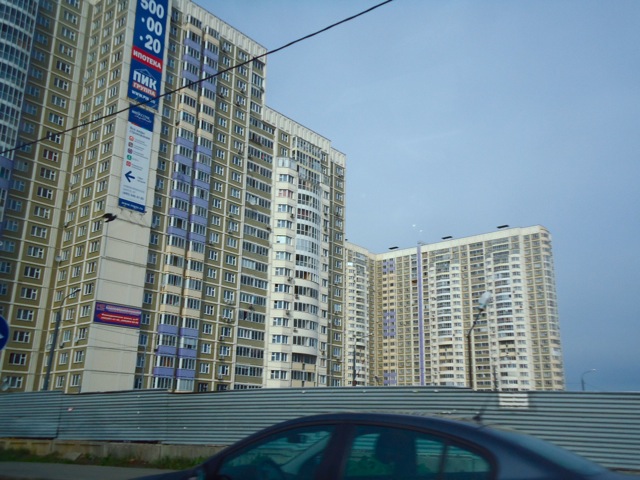 |
| Rows and rows of new apartments in the exurban expanses of Kurkino |
Friday, September 16, 2011
A trip to the 'Main Universal Store'
 |
| Moscow's GUM department store was built in the early 1890s, a mix of traditional Russian architectural themes with contemporary glass and iron engineering. |
I went through a very distinct phase in my youth when the idea of a "shopping mall" embodied everything I thought was wrong about the world. Such commercialism! how shallow and pointless, all those people wandering around like cattle. Like, man, it's all so corporate.
But as I grew older, and my sense of irony became real instead of forced, I developed a real interest in these places, and not just because they are the emblematic structures of late 20th American public life. They belong to the world, to capitalism and modernity itself. Didn't Walter Benjamin spend his working life on vast, unfinished thought experiment about the arcades of Paris, the forerunner of the modern shopping mall?
Though to be honest, what really changed my mind was living in a small village like Williamstown, where getting to any retail center is major work (I have no idea how people lived there without the internet and Amazon). Whenever I drop off or pick up anyone at the Albany airport, I make time to wander around the Crossgates Mall of Colonie Center, usually withouth buying anything, just to look at things. There is always that weird shudder at Barnes & Noble, when I see in reality a book I've read a lot about.
In Moscow recently, I took my daughter to visit Red Square, and we did the usual things. We watched the changing of the guard at the war memorial, had lunch at Okhotny Ryad, listened for the bells of Spassky Gate.
But I also took her to GUM, the enormous 19th century shopping edifice that occupies the eastern side of the Square. I hadn't been there since my first visit in 2003, and was curious what it looked like now.
The answer, of course, is awfully elitny. The Glavnyi Universalni Magazin enjoys pride of place like no other shopping center in the world. And the inside shows it, with a painfully high-end string of boutiques filling a space that is remarkably beautiful in a very practical way.
 |
| The fountain, in the central courtyard of GUM, is decorated for the season. |
 |
| A funny piece of Soviet nostalgia: the store, with its blank, descriptive name ("Gastronom No. 1") and window full of Soviet-era essentials like flour and sugar betrays its real identity. Inside, you won't find much to be nostalgic about, but lots of incredibly expensive imported wines, cheeses, truffles, and whatnots. |
 |
| A map of GUM. Notice the trapezoidal shape. |
 |
| This unique news kiosk reflects the interest of most GUM shoppers: glossy gossip tabs, psychology magazines, business titles, and, of course, a magazine solely about luxury wristwatches. |
Sunday, April 19, 2009
Hillsborough
“I was still on the road when the match began, and after two minutes the radio commentator said that something was wrong. There was trouble on the terraces behind the Liverpool goal. There was a sad, not-this-again feeling in his voice, a quality of resignation, that the supporters, especially those from Liverpool, were sacrificing a game of football to pursue their own violent entertainment: again.. The play continued, but you could tell that the commentator was not watching it, that he was trying to figure out what was happening on the terraces. He couldn’t definitely say that it was crowd trouble, but it was something serious, and the police were gathering near the spot. And then, in an instant, that was it: the game was over. The referee had been told by the police to stop play. That was about the time I arrived home. The stadium was about to become the most famous in the world.” -- Bill Buford’s description in his 1990 book Among the Thugs of hearing about the Hillsborough stadium disaster, twenty years ago last Wednesday, in which 96 fans were killed.There were lots of opportunities to think about what sports means last week. Wednesday marked the twentieth anniversary of the Hillsborough disaster, when 96 Liverpool FC fans were crushed to death as an FA Cup semifinal against Nottingham Forest got underway. There are many layers to what happened, particularly about tragedy and memory, but also about sports' changing place in society. There are many interesting things about how the 96 victims are remembered. In many ways it fits in with how other major public tragedies are remembered -- particularly the emphasis on ritually reading aloud the names of the victims, which you see in memorials to Sept. 11, and the Vietnam war. There is also an active and vibrant set of conspiracy theories that abound, and the belief that justice has not yet been served. And the the tragedy's legacy includes many unique quirks, such as the way that the Sun newspaper remains hated in much of Liverpool to this day due to its lurid and unfounded allegations of Liverpool hooliganism at the tragedy. But at the same time, the entire event seems tinged with a bit of self-pity -- 1989 was the absolute low ebb of English football. It was serving out a ban from European competition at the time as punishment for the Heysel Stadium disaster in 1985, in which Liverpool fans played an unfortunate role. But unlike too many tragedies, this one’s long-term legacy is positive: the investigation into what happened, the Taylor Report, produced a list of recommendations that essentially gave football a chance to start over. They recommended such things that seem so obvious -– like having seats in stadiums, instead of just pushing people into terraces which, as Buford notes, police actually referred to with the same language as moving herds of cattle: “pens,” “cages,” etc. It marked the start of the modern game: a big-money generating, largely respectable, family-friendly form of entertainment. It is a little ironic that the anniversary –- widely noted in Europe but ignored here in the States -– came just as the New York Yankees inaugurated their current fortress of capitalist bounty: its new $1.5 billion, taxpayer-supported stadium whose most expensive seats are $2,500 and have teak armrests. All this points out the strange paradoxes of sports, that is at the same time nothing more than and much much more than watching grown men play childrens' games. What it all means, and who cares about it, is always subject to change and cycles. English football changed dramatically one afternoon in 1989 – but even so, a 2007 poll found an overwhelming majority of fans want standing terraces to return. And here already, the new Yankee stadium is a monument to another era -– of leveraged capital projects, unchecked greed, and blissfully entertaining unreality. Yet another of the fascinating things about this economic crisis is to see what role sports will play in society at the other end.
Monday, November 24, 2008
Ulitsa Varvarka
 Ulitsa Varvarka is one of the most interesting little streets in the heart of Moscow. To appreciate how much so, you probably have to have seen it when the Hotel Rossiya towered over it. It is the subject of the last of my freelance pieces from Russia, which appeared in the Boston Globe's Travel section on Sunday. Click here.
(Above, a view of the Cathedral of the Sign, with the walls and towers of the Kremlin in the background. Below, the Old English Embassy, in front of the vast construction yard that was the Hotel Rossiya).
Ulitsa Varvarka is one of the most interesting little streets in the heart of Moscow. To appreciate how much so, you probably have to have seen it when the Hotel Rossiya towered over it. It is the subject of the last of my freelance pieces from Russia, which appeared in the Boston Globe's Travel section on Sunday. Click here.
(Above, a view of the Cathedral of the Sign, with the walls and towers of the Kremlin in the background. Below, the Old English Embassy, in front of the vast construction yard that was the Hotel Rossiya).

Wednesday, September 24, 2008
Cold and heat
The "home heating season" at our house began last Friday, when Olga and I noticed as we ate our bagels at breakfast that we could actually see our breath. Heating oil prices being what they are, this is not a step taken lightly, but we have a lot going against us at our new place. It faces west, so it only gets a few hours of sunlight at the end of the day, and just to the east of us is a stand of huge fir and maple trees that cast a nice shade in the summer, but ensure we live in darkness and cave-like chill.
We think a lot about the absurdity of all this. In Russia, no middle class family sits in their own home wrapped in blankets watching their breath turn to frost. And none of them risk bankrupting themselves to pay for heating fuel either. The old joke goes that in Russia your thermostat is you window: you open it to let the extra heat out. One of the positive legacies of socialism are home utilities. In most cities, every district has its own cogeneration plant that pipes steaming hot water to each apartment for heating and hot water service. It is massively inefficient, though it isn't an urgent public policy priority because Russia has the resources, and as with almost everything, the situation is dramatically different in the provinces. Half of the Siberian city of Kransoyarsk was without heat or hot water for several weeks last winter because one of their plants blew up. All that is very bad, but when I first heard this coming winter in New England referred to as a potential "frozen Katrina" -- with ordinary people freezing to death in their homes because they can't afford to heat themselves -- I began to wonder. Sure, the Russian way is built on faulty assumptions about its sustainability and disregards society's most vulnerable members, but isn't it the same here? Isn't our dependence on oil furnaces and getting by with paltry insulation a reflection of the mistaken belief that heating oil would always be cheap and abundant? and isn't LIHEAP such a pressing political issue around here because there are way too many people who are broken by the costs of heating?
It seems like another subtle reminder that the way things are done here in the States isn't perfect. It also points out one of the most common and absurd stereotypes I've encountered here, in which people respond to our year in Moscow by joking that it must've been cold. Well, actually, no. America is cold. Every place I went in Russia was heated abundantly and comfortably, and when you go outside, you dress for it. Hats, gloves, scarves, thermal underwear. Russians know that you don't screw around with winter, and as a result, it isn't that bad. Compare this with here, where winter is a long slog of dull, low-level misery. Of wet and chills and once the holidays are over, a kind of sunlight-free existential despair. It is no wonder that so many northern retirees cite simply avoiding the winter as the reason they pulled up roots and moved South.
Thursday, June 5, 2008
The view from Sparrow Hills
Last week, Olga took me for a walk around her alma mater, Moscow State University, because I'd never been to that part of the city before and wanted to see it. From the university it is a short walk to Sparrow Hills, a steep hill over a bend in the Moscow River that offers easily the best views of the city.
Moscow is a sprawling metropolis, and it really isn't designed to be actually seen from a detached perspective like other cities. There is no skyline as it were, just buildings and smokestacks in the distance. You realize this from Sparrow Hills, which is impressive, but makes you feel like a bee that has just looked back at his kicked-over hive.
Here is the view looking a little to the north. Moving from the right to the left, you can see three of the spires of Stalin's famous "Seven Sisters," which are each impressive in their own right but never really -- in my opinion at least -- dominate the skyline as some people think. At the far right is the Foreign Ministry, moving to the left in the distance is the Kudrinskaya apartment block, and in the center (near the smokestack) is the Hotel Ukraina. That little bit of Singapore that seems to have dropped out of the sky on the far left side is the famous "Moscow-City" complex, the new business heart of the city that will eventually feature the tallest building in Europe.

This next photo below is a shot looking a little to the right. Right up front is the stolid mass of Luzhniki Stadium, the home of the 1980 Olympics. Looking just above it, you can see the Cathedral of Christ the Savior with its gold dome. Just a bit further past it, you can kinda make out the gold domes of the Kremlin's cathedrals as well.

Moscow is a sprawling metropolis, and it really isn't designed to be actually seen from a detached perspective like other cities. There is no skyline as it were, just buildings and smokestacks in the distance. You realize this from Sparrow Hills, which is impressive, but makes you feel like a bee that has just looked back at his kicked-over hive.
Here is the view looking a little to the north. Moving from the right to the left, you can see three of the spires of Stalin's famous "Seven Sisters," which are each impressive in their own right but never really -- in my opinion at least -- dominate the skyline as some people think. At the far right is the Foreign Ministry, moving to the left in the distance is the Kudrinskaya apartment block, and in the center (near the smokestack) is the Hotel Ukraina. That little bit of Singapore that seems to have dropped out of the sky on the far left side is the famous "Moscow-City" complex, the new business heart of the city that will eventually feature the tallest building in Europe.

This next photo below is a shot looking a little to the right. Right up front is the stolid mass of Luzhniki Stadium, the home of the 1980 Olympics. Looking just above it, you can see the Cathedral of Christ the Savior with its gold dome. Just a bit further past it, you can kinda make out the gold domes of the Kremlin's cathedrals as well.

Friday, May 30, 2008
History must work
 I had last Wednesday off, and took a trip down to visit Park Pobedy, Russia's primary war memorial, located down along Kutusovsky Prospekt west of the city center. I went knowing full well that it isn't quite the soundest intellectual experience in the city, but I was curious.
 The giant park itself is probably the last real Soviet space -- planning for it began in Soviet times, but it wasn't actually completed until 1995. It sprawls with fountains and paved plazas. And considering the way Moscow's real estate market is developing, this is certainly the last big development here that won't entail a shopping mall, "business center," condos, and underground parking.
The Park Pobedy metro station is one of the system's newest, and you can tell as you step off the train into the gleaming bright halls. Unlike most station, there is no Soviet kitsch hanging around, just simple designs. On the one hand, it feels cleanly modern, but on the other hand it feels a bit like a western European airport.
You pop up on the Prospekt near the 1812 Triumphal Arch, and the park opens up before you. Wednesday happened to be the day to celebrate the Border Guards -- their 90th anniversary no less. Whenever any of the security branches celebrate their name-day, all the veterans don their old hats and medals, invade some prominent public space, get scandalously drunk, and do everything they can think of to embarrass their entire service. The park was full of former border guards wearing their distinctive bright green halo-hats. They were a bit better behaved than the celebrating paratroopers and sailors I'd seen before, but not by much.
The park forces you to walk about half an hour through a vast square lined with fountains and thick with obscure symbolism -- five terraces for the five years of the war, and the like. Soviet public planning and architecture is deliberately about alienation, a conscious effort to make the individual feel useless and absurd in the presence of a space that is designed for no earthly being, and only derives its value from its emptiness, implying that only raw volume alone could possibly fill it up.
Park Pobedy offers the interesting aspect of forcibly shoving in the exact same space the two worst things to happen to
The centerpiece of the park is the
But even worse, the space is designed to put history to work. It is not an educational experience, it is an indoctrination. The lower level features the "Hall of Memory and Sorrow," a long, dimly lit hallway lined with vitrines featuring volumes listing the dead. Hanging from the ceiling are million of different sized crystals dangling from thin gold chains -- representing, naturally, the millions of tears shed, etc. The hall eventually leads you up to a secular pieta of a stout Russian woman holding on her lap a deceased soldier.
Surrounding the hall are the dioramas, which sum up the fast hit nature of ideology. I guess I expected something more than the large, dusty paintings I saw, but I was starkly disappointed in what I saw. They start with the
Upstairs features the Hall of Glory, a giant domed space with the names of all the Heroes of the Soviet Union engraved on the walls (interesting fact: seven unrelated men named "Mikhail Borisov" were Heroes). In the center is a typical "Bronze Soldier" kind of statue. Apparently, they swear in new officers there.
I remember a few years ago when the
###
Friday, May 16, 2008
A trip to Vladimir, part two
The main street, with its belching buses and long blocks of Stalin-era housing, is not the best way to see the city. We discovered running exactly parallel Herzen Street 


Above is the city of
----------------

This strange thing on Lower Moskovskaya Ultisa is a monument to the victims of the Chernobyl Disaster.
-------

At the western end of downtown is the
-----------
The downtown is located on a long, steep hill over the Klyazma River. Considering the flat expanse of

Monday, May 12, 2008
A trip to Vladimir, part one

Earlier this month, we spent a week in the city of
And of course, it is hard for someone from
-----

The center of the city is

The church sits on a bluff of land over the
----
Nearby is St. Dmitry’s Cathedral, a smaller and less imposing structure but amazing all the same. The outside is covered with incredibly detailed images from the life of King David.

The hard thing about visiting UNESCO world heritage sites with an 18-month old is that you have to keep one eye on the priceless architectures and reliefs, and the other on a running around 18-month old.

------
The great thing about travel is going through all the effort to put yourself in a strange situation, and then taking it for granted long enough that you are surprised when you realize just how weird everything has gotten. This is an awkward way of saying that we passed this scene nearly every day not far from our hotel,along the main street, Lower Moskovskaya Ulitsa. The building, like many old wooden ones of its era, is leaning one way. Behind it is an Old Believers’ Church, that is apparently off the tourist beaten track.

--------------
Residents apparently can’t put much faith in their local government, but happily, there is a political party that can help! Putin’s United Russia graciously sponsored a playground in the center of town where we frequently went to play.

This is very peculiar to me, and reflects just how profoundly party politics here is nothing more than a matter of branding. The brand creates all the fun stuff, like playgrounds, while the “serious” business of cleaning up trash and fixing potholes is up to the government. It is a sign of severe decay in the civic infrastructure when these two endeavors – politics and government – are considering completely separate in the eyes of most Russian subjects.
Friday, May 9, 2008
Victory Day

On our recent trip to the city of
Victory Day is probably the most important Russian holiday these days, much much more than anything like Memorial Day or what we have in the West. It manifests itself in clear ways -- the orange and black ribbons people started wearing a few years ago -- and it serves as the sort of unofficial start of the warmer months, when everyone starts getting their dacha into habitable condition again. It also happens to be when television seems to show nonstop for two weeks old Soviet war movies (and, I would dare to hope not coincidentally, a few American ones two. This week I saw Thirty Seconds Over Tokyo and Saving Private Ryan on national t.v. This is a big deal considering that in the popular understanding is that
There was a big parade this morning on Red Square, which made quite a fuss because
Anyway, there is something very unsettling about Victory Day. Selective history at work on this scale is never pretty, but the degree to which
Part of it seems to be out of respect for the remaining veterans and their memory, but it is hypocritical. Young Russian proudly wear their ribbons, and indulge in some patriotic self-congratulation, and then on May 10 return to ignoring the pensioners in their midst, who continue to live on meagre pensions, in inadequate housing, with incredibly poor health care.
Everything I've seen of this country suggests to me that these willful myths are destined to become core components of the national character. The unimpeachable heroism of the war will go right up there with the "Tartar yoke," the murderous treachery of Poles, the insistence that
The simple fact is that the fight against fascism is one of the most heroic and important moments in human history. The sad fact is that the
Sunday, February 10, 2008
Primary day
Everytime you go to vote it's a little democratic adventure, especially when it happens in an unlikely place. Today the Russian chapter of the "Democrats Abroad" held their primary, giving me a chance to drop a ballot in this year's fierce race. There are 22 delegates up for grabs to be decided by Democrats living outside the U.S., and we'll know the results sometime midweek. Here are some pics...

First a word about getting out an about in Moscow: there are always adventures. The nearest Metro stop to the polls was at Paveletsky Station, which has you can see is undergoing a major round of renovations. Specifically, this interesting train station used to have a big public square in front of it, which is now a vast construction sight. The current thinking in central Moscow is that empty space is useless space. So they are putting up a mall, because you can never have too many places for bored New Russian housewives and mistresses to buy shiny baubles and whatnot. We've been promised that the new mall will somehow reflect the train station's design -- which judging from this awful, recently built clocktower on the right, is almost certain to be yet another architectural catastrophe.
===

The view looking up Kozhyevnichyeskaya Ultisa from the station.
===

A view of the Vodootvodny Canal
=====

"Business centers" in Moscow have a lot of things in common: soulless, cookie-cutter modern architecture that appeals solely to 'biznesmen' who grew up in soulless, cookie-cutter Soviet architecture; lots of entrances, car-parks, and gated courtyards; and a battalion of security guards to give former security service personnel something to do with their day.
So I admit I was unsure about finding the place, let alonw what hassles would await to get inside. Turns out I needn't have worried: Russian media interest in the primary and American politics in general has been very high. So I knew when I saw the satellite trucks that I'd found the place.
====


Ballot box, Moscow-style.
===

You never really get far from the past in Moscow. A detail of the decorative plates atop the columns in the Paveletskaya metro station as I was heading home.

First a word about getting out an about in Moscow: there are always adventures. The nearest Metro stop to the polls was at Paveletsky Station, which has you can see is undergoing a major round of renovations. Specifically, this interesting train station used to have a big public square in front of it, which is now a vast construction sight. The current thinking in central Moscow is that empty space is useless space. So they are putting up a mall, because you can never have too many places for bored New Russian housewives and mistresses to buy shiny baubles and whatnot. We've been promised that the new mall will somehow reflect the train station's design -- which judging from this awful, recently built clocktower on the right, is almost certain to be yet another architectural catastrophe.
===

The view looking up Kozhyevnichyeskaya Ultisa from the station.
===

A view of the Vodootvodny Canal
=====

"Business centers" in Moscow have a lot of things in common: soulless, cookie-cutter modern architecture that appeals solely to 'biznesmen' who grew up in soulless, cookie-cutter Soviet architecture; lots of entrances, car-parks, and gated courtyards; and a battalion of security guards to give former security service personnel something to do with their day.
So I admit I was unsure about finding the place, let alonw what hassles would await to get inside. Turns out I needn't have worried: Russian media interest in the primary and American politics in general has been very high. So I knew when I saw the satellite trucks that I'd found the place.
====


Ballot box, Moscow-style.
===

You never really get far from the past in Moscow. A detail of the decorative plates atop the columns in the Paveletskaya metro station as I was heading home.
Subscribe to:
Posts (Atom)