Showing posts with label Russia. Show all posts

Friday, July 18, 2014

A stupid game

I've been slowly getting through Orlando Figes' recent book about the Crimean War, seeing how relevant that part of the world has become again. What strikes you first is just how much of an anomaly the Soviet experience was, and how quickly Russia jumped back to earlier times. To when Russia was a socially retarded, violent, paranoid feudal state, with a ruthless top-down power structure, a complicit national faith with delusions of being the next Roman empire, and a swaggering sense of racial superiority.

It's often tempting to leave them alone and deal with them as best we can, but what happened to the Malaysian Airlines flight yesterday shows what happens when this bullshit spills over. 298 people who had nothing to do with this stupid little farce in eastern Ukraine were blown out of the sky, and setting aside all the usual caveats about what we know and don't know, the moral dimension is very clear. To Putin's power structure this is all a big f-ing game. It's jaw-dropping how creative the bootlicking Russian media has been happy to publicly fantasize about what might have happened.

The news yesterday was a huge shock to those of us who have continued to follow the news from Ukraine closely. It has felt for awhile that the situation was beginning to sort itself out. That with Crimea firmly in hand, Putin wasn't all that interested in a huge flare-up in the east. And the quiet support from Moscow was worrying the separatists enough that they began whining about being abandoned. And the world was beginning to see what was happening — that these separatists were a small, violent minority made up of the usual unemployable lot of track-suit wearing losers you find getting drunk in housing projects all over Eastern Europe.

I hope the world can maintain a sense of outrage about this, and that there will be real consequences for this regime. But I don't expect that will happen. The history of civilian aviation is full of moments like this — when airline passengers have been murdered by misunderstanding — and nothing really changed.

Putin and his crew don't care what the world thinks. Holy Russia is beyond reproach, and all that matters is the integrity of the internal "power vertical." And worse, as David Remnick pointed out on the New Yorker website: "Vladimir Putin, acting out of resentment and fury toward the West and the leaders in Kiev, has fanned a kind of prolonged political frenzy, both in Russia and among his confederates in Ukraine, that serves his immediate political needs but that he can no longer easily calibrate and control."

Tuesday, March 18, 2014

Russia as it was, as it will be

I've been looking at that last post above, and how much things have changed since then. It's been an amazing, and profoundly depressing few weeks for those of us who have an interest in Russia and its future. I've been paralyzed over how to begin to make sense of all this here, my attitude and fears about what's happening keep changing — becoming reliably more bleak.

There has been a lot of interesting commentary about all this. I think Julia Ioffe at the New Republic did the best job of capturing just how sad it has been to watch from afar this descent into madness:
"Westerners rightly know Russia as a font of absurdity, but lately, it’s been hard to keep up: I’ve been trying to write this post for a solid week now, and have been constantly derailed by the increasingly bizarre and worrying developments coming from the Trans-Eurasian Development Belt."
She ticks off some of the nonsense. The absurdities issued by Kremlin flunkeys in the Duma, the belligerent posturing of the neckless tough guys that dominate the Russian conversation, the inability to discern just where all this ends.
"Here’s what’s scary about this: this is all being done, according to various reports, without any consultation with anyone outside Putin’s shrinking inner circle of old KGB spooks. The economic elites most likely to suffer from a plummeting ruble and sanctions have been shut out of the decision-making process. This is all about intangibles, the things that reason can't hook, the things impervious to logic and reasoning and even the cynical algebra of geopolitical interests. This is about pride and values and the Trans-Eurasian Development Belt. 
And, yes, all of this is familiar and increasingly terrifying, but to whom? To you and me and an increasingly besieged island of Moscow liberals? Because, terrifyingly, familiarly, all of this works. The method has been tried many times, and it is true: Putin’s approval ratings have grown to their highest level in three years."
For 15 years, Putin in plain sight wrote the blueprint and assembled an apparatus for a new kind of autocratic oppression. And now we're watching it click and whir into life.

Wednesday, February 26, 2014

Power stupefies

Watching events unfold in the Ukraine over the past few days I've been working over in my head a single question: Was there a specific moment in the last few years when former President Viktor Yanukovich said to himself, "Screw it, I'm going to go ahead and put in the pirate ship-themed dining room and start a private zoo. There's no way that could possibly come back to haunt me."

It is a moldy old saying that power corrupts, when it seems more precisely that power stupefies. Something about being a ruling oligarch makes you think there's no way you could ever be knocked off, and looking from afar, it is hard to believe anyone could be that deluded. It is probably a bit like winning lottery — everyone is convinced they aren't the guy who is going to go bankrupt in a few years after they win, but it keeps happening over and over again.

The Ukraine is a great case study in the ways things just don't change, and how patterns keep repeating in new and wonderful ways. So I watch thing with a very cynical eye, and chortle when I hear commentators in our stunningly earnest and ignorant American media declare, "Well Joe, I tell ya all this started in the 1930s with Stalin." (Only Americans are young enough at heart to say things like that).

I'm incredibly pessimistic about things because I've been following things there closely, and I remember the Orange Revolution. That last outpouring of popular unrest in the Ukraine was enough to scare Russia to its core, and convince Americans that the Ukraine was all set for the future and didn't need anymore attention. But as events unfolded, the new power structure revealed itself very quickly to be just as venal and greedy as the last one. To say, "they blew it" is an understatement. So the stunning events of last weekend were a real downer. I wish it were possible for the public persona of Yulia Tymoshenko to immediate skip from her heroic release from prison and go straight to the cheesy "Evita" theater spectacle featuring her hairdo. Too bad she's going to insist on proving how corrupt she is all over again — and perhaps someday the masses can take selfies in her gold-plated hot tub or with her vintage car collection.

With leaders like these there's not a lot to hope for. Yanukovich was a singular case, such a clown that even Russian is embarrassed to know him (I sincerely hope we someday find out that his tragicomic flight from the mobs included him dressing up as a nun and slipping out a hotel kitchen). But the opposition is reduced to Tymoshenko's flunkies, some nationalist groups that remind you just how scary the far right is in central and eastern Europe, and a celebrity boxer. If only it were just as easy as deciding between owing your soul to Russian oligarch or the German bankers.

The powerful act stupid because they don't believe things will change. At that level, you have to create such world views or you don't function. And I think the rest of us feel it too. All through last week, when the streets were on fire and the bodies were stacking up in the hotel lobbies, it felt like that feeling amped up to 11. How could this possibly end? how could anything change?

And then on the weekend, it did. Everything we will hear in the coming months will suggest that it was the only outcome possible, but of course it wasn't, and it certainly never felt that way as it happened. Scenes feel like they'll go on forever until they don't. Growing up I didn't believe in the possibility of a generation defining event like Pearl Harbor — I thought that right up to Sept. 10, 2011. It always comes as a surprise. Vladimir Putin and Jamie Dimon take note.

Sunday, May 13, 2012

Moscow space

Traffic and construction: looking north from Mayakovskaya Square
Every time you return to Moscow you must readjust your vision. It is a place that changes very fast, but seems to remain within the same outlines. Was that high-rise apartment block there before? is this shopping center new? was there always this much traffic on this road?

This is the consequence of barely manageable growth. The traffic gets worse by the week and the Metro is a flood-chute of humanity, streaming and stalling people from the mushroom moon colonies on the outskirts through the straining and bursting center. Muscovites resort to increasingly absurd lengths simply to live and move around.

The city gives you lots of time to think about the situation, and how civil authorities are not just helpless, but actively taking steps that history has proven will only make things worse. They build new highways, they add lanes to existing ones, the plan entire new subway lines with dozens of new stations, the acquire enormous swaths of suburban territory to accommodate increased urban growth.

Moscow is a city that aims to be New York or London, but ends up being more like Mumbai or Lagos. And it comes at the expense of the rest of the nation, especially the countryside, which is withering.

So while Moscow's progress through the phases of being a global megacity, there are signs that the investments and heavy-handed, top-down approach of the Putin years are having some effect on the urban landscape. Walking around the Center this month, it felt like visiting a familiar place where the scaffolding had come off after many long years. There are more new buildings, old ones have been renovated, and it seems like there are more long, clean views around the place.

It can't be a coincidence that this is happening during an election year, when a carefully stage-managed "transfer of power" is underway and the chorus of dissent is growing bit by bit.

Nor is it surprising that much of the new building is terrifically tacky. The long Soviet experience left a two-fold legacy on Moscow's physical space: a reverence and overvaluing of the monumental and gargantuan for its own sake, and the belief that only shameless, flashy, blinged-out, busy details and ornamentation are the only ways to communicate serious value. It's why, for example, the Ritz Carlton hotel on Tverskaya looks like it has about a million bricks more than it actually needs, and why every oligarch and high-level bureaucrat wears a platinum wristwatch the size of a tea saucer.

Anyway, some pictures:

The Central House of Artists on Krimsky Val, built in 1980, remains the most starkly astonishing example of Soviet modernism at full swagger 
The brand new Ritz Carlton, built a few years ago a stone's throw from the Kremlin on the site of the former Intourist Hotel, led me to make up a new word: "encrustulated" 

The "new" Hotel Moskva is said to be a replica of the old Stalinist one, which you may recognize from Stolichnaya vodka bottles 
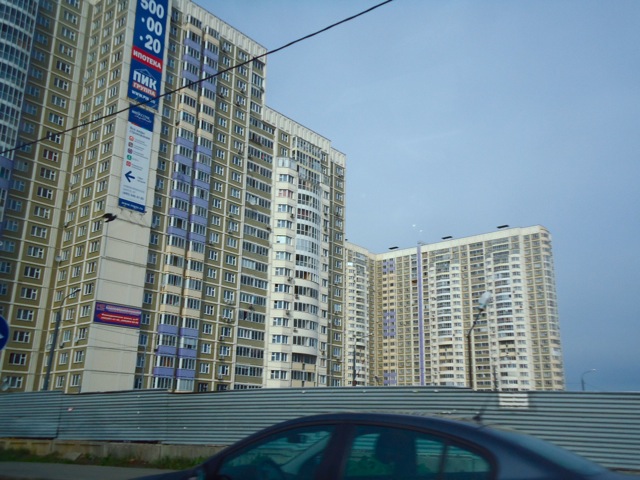
Rows and rows of new apartments in the exurban expanses of Kurkino

Wednesday, May 9, 2012

Scenes from Victory Day season in Moscow

Victory Day (день Победы) remains one of the most important Russian holidays. Recent years have seen the celebrations return to Soviet chest-thumping, with marching phalanxes of troops, rumbling tanks and ICBMs, and fighter jet fly-bys.

But as with any big holiday, it is also an occasion for a season of kitsch.


A Victory Maypole? This collision of banners and colors was on Krimskiy Val, across the street from the entrance to Gorky Park.


For fans of military history, this huge map of the campaign was installed at Revolution Square.


"Everything is important!" — This somewhat cryptic remark is the slogan of a housing developer, which sponsored this ad near Barrikadnaya. It's a very common Victory Day theme that is disturbing: young children dressed up in WWII-era uniforms and themes. It is intended as a sign of respect, but it also wants to signal the unquestioning readiness of future generations to make horrific sacrifices.


"The Motherland Salutes You, Hero-Fried Meat Pastry!" —this poster was spotted in the window of a chebureki shop on Ulitsa Solyanka, near Kitai Gorod.

Tuesday, May 8, 2012

What changed after Bolotnaya?


I spent the whole winter watching in surprise and amazement at what was happening in Moscow. Back in June when it seemed we would spend the year there, I wasn't looking forward to it. A year in a grim, expensive, depressed city where everything stays the same forever (except when they get worse). If the outcome of several exciting months is precisely what any safe bet would have been a year ago — Putin taking the oath for another term in the Kremlin — the very process, I thought, must have changed something.

So when we went to Moscow last week for family matters, I had my eyes and ears open. And on Sunday, the day before Putin's inauguration, I had the chance to see to see the state of civil society for myself.

The gathering was organized at Bolotnaya Square, scene of the first great moment back in December which already feels like ancient history. Despite being a sprawling megacity, Moscow's heavy-handed top-down authority keeps the chaos to a minimum, and we could tell something was up once we got to the Metro and announced several stops in the center were entirely shut down. The closest we could get was Novokuznetskaya, and since we'd already missed the march portion of the event, which was on a parallel street, we got out there and walked along the river.

That gave us a chance to the police staging area just east of the square. Lined up along the bridge just east of the square was some sort of staging area. The word "phalanx" is one I'd never really thought about, but there it was. Row after row, several deep, of fully-equipped riot police, in helmets and face shields, body armor and batons, just standing, waiting to be pointed at something. Coming upon them gave me a sense of the shock and awe of an 18th century battlefield, of coming over a hill and seeing the enemy all ready, with their shit together, ready to jump on you. It almost feels like that alone is half the battle. In this case, it was far more menacing because there was not display function in any of this. This was the backstage area, not even a show of force. 


We walked along the river to the entrance. Bolotnaya Square is a peculiar little stretch of asphalt on the south side of the long, narrow island that sits in the middle of the Moscow River. Geographically, it is incredibly close to the Kremlin, but practically, it is another world. It is accessible only by a handful of bridges. We crossed one, going through the first police checkpoint, which led to the western end of the square. From there we were channeled into it, toward where they had set up a stage and sound system, which was blaring classic Russkie Rock hits from Kino, and Nautilius Pompilius. On our right was the river, on our left, behind a row of port-a-johns and temporary metal fences, were a full line of police men.

We spent awhile as people streamed in, and watched the group. It was very diverse. There were certainly a lot of young people, the kind I would imagine attending an anti-establishment protest in the West. But there were older people, who looked like they'd been in the spirit of protesting their whole lives. A few had clearly anarchist signs, others outright Soviet nostalgia. But most were perfectly normal-looking middle class people, a few brought their kids.

As everyone filed in, I made note of what I thought must be a major achievement in the creation of Russian civil society: the whole thing was pretty boring. There wasn't much happening. It was a strange feeling: overall, it felt as if the authorities had made peace with the idea of larger-scale protest. The march was permitted, and more or less kept to the shape of several earlier peaceful ones which had gone off without a hitch under much more uncertain circumstances (i.e., it wasn't perfectly clear the regime had won yet). There were rumors that troublemakers were interested in starting some sort of "Occupy" camp near the Kremlin at Manezh Square, and we saw one hippie-looking lad on the subway carrying an LL Bean outlet's worth of camping gear, but we figured just a few fools would get themselves arrested. It seemed like everything was going to be boring, and the greatest challenge was going to be to figure out how to sustain the momentum through the long, long years stretched out ahead.

Everything shifted quite abruptly. Everyone who had gone ahead of us seemed to at once stop, turn around, and start walking back. Word spread through the crowd that the organizers of the event — Nemtsov, Navalny, Udaltsov, I believe —had been turned away (or had refused to go through). There appeared to be a sudden, intense stand-off behind us. Everyone had turned around. Someone from the perfectly superfluous stage announced that the meeting had been cancelled. It was hard to figure out what was going on, and so we began to make our way home.

We didn't hear about the violence until much later when we arrived home. Everyone was looking in the direction of what was happening, but we couldn't make anything out. The worst we saw was an NTV television van getting a working over. It was already piled with rubbish, and a crowd was pelting it with trash as we walked by. A line of indifferent police officers were standing a few feet away. I saw a perfectly respectable, middle-aged woman, who looked like she could have been a middle school art teacher, appear at my shoulder and hurl a glass bottle at the van, with an indescribably angry face. It was perhaps the only moment of real nervousness I felt, like a mob was about to turn very ugly. Meanwhile, back at the Square, things had already turned ugly, when a few provocateurs and an army of hyped up police goons made the news that would be seen around the world.

We made our way back toward Ordynka. It was our last night in Moscow, and my hankering for ethnic food led me to suggest we stop for dinner at Shesh-Besh, a decent Azeri chain restaurant, for some shashlik. The restaurant crowd was familiar from any Moscow restaurant — lots of well-dressed people, families with kids, everyone with smartphones, a scene almost Western. But I noticed that almost every single person there had a white ribbon on them.

Coming into this week, this is what I imagined the real value of these protests had been. The worst part about semi-authoritarian regimes is how alienating and atomizing they are. For years you walked around the city, and could never tell what the faces you saw on the street really thought about the political situation. If you hated Putin, aside from your family and close friends, you felt very alone. That all began to change with social media, and with the first stirrings of protest — when those intimate, desperate conversations around the kitchen table (an almost permanent feature of Russian life) were suddenly shared with perfect strangers in public.

Putin's actual inauguration was just as depressing as could be imagined. We watched it having a long breakfast, just before we set about packing for our trip home. The whole thing struck me as some kind of very dumb Disney princess movie, with an OJ car chase in the middle. People who try to deconstruct the details of it — the single camera, the general atmosphere of a very lame, scripted, "reality t.v." show — are forgetting something. Medvedev's inauguration four years ago was precisely the same, the same fetishized pomp and symbolism for no real point.

All this, with the violence, made it even more depressing than I was prepared for. I was ready to admit that while the battles were lost, the struggle wasn't over. That the gains painfully made would not be given up. That the focus would become smaller, on municipal and regional councils, on the hard work of living for a cause and building something beyond the occasional grand gesture. That thanks to social networks and alternate media there was no way the regime could carry on as before. That the sheer weight of corruption, official bullshit, and the countless, needless aggravations that make up life in Russia had finally tipped over and couldn't be set back. That maybe, for the first time in its long history, Russia would experience the kind of gradual, positive social change that would lead to peace and prosperity.

Then I caught myself; that's just wishful thinking. All Russians really have now is exactly what they had before: not much.

Monday, April 23, 2012

'One or two secret policemen along the way'

There is a line in Anne Applebaum's review of Masha Gessen's new book about Putin that that is so inaccurate and mendacious I can't believe it appeared in print, let alone in the New York Review of Books. Describing Yuri Andropov's response to the 1956 Hungarian Revolution, when he was the Soviet ambassador to Budapest, she writes,

He had been shocked when young Hungarians first called for democracy, then protested against the Communist establishment, and then took up arms against the regime, even lynching one or two secret policemen along the way. 

First a factual note about those "one or two secret policemen along the way." On Oct. 30, 1956, a mob lynched at least 24 AVH conscripts at Köztársaság Square. A photographer for Life magazine was at the scene, and it's tough viewing if you agree with me that murder is murder, no matter who does what to whom. 

But just as bad is her glib effort to make 1956 fit her world view. The uprising was remarkable for the breadth of its support -- young and old -- led first and foremost by left-wing, Marxist intellectuals and students who wanted a better form of socialism. They were joined a huge outpouring of support, including from many veterans of the extreme right. One eyewitness recalled that the uprising included the first reappearance of open anti-Semitism in Budapest since the Holocaust. 

By clumsily tromping outside her area of "expertise," she's let her stereotypes and assumptions show, and provide an insight into the Russophobic recesses of the neoconservative soul. This mix of provincial arrogance and willful ignorance is tragedy when we stumble into avoidable wars and prop up dictators, comedy when George W. Bush gets shoes instead of flowers thrown at him, and irrelevant when authentic people-led movements for social change -- in Serbia in 2000, across the Arab world last year, and in Russia right now. 

There's something pathetic about this unending desire to keep fighting the Cold War. Applebaum has plenty of places that will pay her for these thoughts, which she has honed as a fellow at the American Enterprise Institute and which have been feted by the most dishonest intellectual engineering project in Europe. So how she became NYRB's designated Russia expert is a mystery.

Monday, March 5, 2012

Putin's certain victory begins an uncertain era

So, the ballots have been cast, the numbers have been revealed, the tears have been shed, and the political reality for Russia for the next six years is, despite months of protest, precisely what is was when Putin and Medvedev announced they were swapping jobs. About the actual voting and whether or not the totals bear any resemblance to reality, I am capable of no sensible opinion. Putin probably would have won cleanly, but I still don't buy that there was no funny business.

Following things closely through these months, two things strike me. The first is the extent of the panic response from Putin, which shows clearly that the groundswell of opposition in the cities registered on his reptilian fear sensors. To an amazing degree, the establishment trotted out the familiar lines of anti-Americanism and retro appeals to the security of a state surrounded by hostile powers. This is the reliable old playbook from the 1920s.

The second is about the new role of the Internet in Russian life. For years, on LiveJournal and Twitter and other sites there have been rumblings of dissent that never seemed to gather any steam. All that changed in the past few months. Throughout the campaign I was wondering when we would see the government tighten its hold on new media, even as we saw state television go full in the bag, and pressure ratchet up on independent news sources like Ekho Moskvy. Would we see a ham-handed clampdown like the ill-fated Mubarak regime last year? or something more successfully sinister like in Iran, or sophisticated as in China? As I understand it, there was nothing of the sort at all. The Internet appears to remain open and free, which makes me wonder whether the Russian government is even capable of bringing it to heel if it wishes. That makes for a fascinating new normal in Russia.

It will be incredibly interesting to see how Putin chooses to govern over the next, sigh, six years. Will he keep up the paranoid thundering about enemies foreign and domestic at Volume level 11? does the nation have the stamina for another generation of such toxic nonsense? does Putin have, somewhere, a better angel of his nature that realizes he doesn't need to push the boot down quite so much, that the dissenters can grouse and groan all they want but can't change the political reality that the voters need not be consulted for another five years? And what if, once beautiful weather arrives, the protesters decide that they've developed a taste for expressing their views and continue to go into the streets?

And exactly how does he plan to ward off the danger of Brezhnevian stagnation? in the campaign, he promised the moon and the stars to the electorate -- and as long as oil prices remain preposterously high, he can deliver to a certain extent. But if something unforeseen happens, then what?

At this depressing moment, there are plenty of reasons to be doubtful and gloomy. But there are enough questions still open to suggest there may be surprises in the future.

Wednesday, February 29, 2012

Life under the boot

There is a photo from my wife's family that haunts me in an unusual way. It shows my mother-in-law when she was still a small girl, standing on the balcony of the family apartment, being hugged by her father, my wife's grandfather. It is taken sometime in the late 1940s, and they are all smiling and laughing.

As a Western who has read and studied those years, something startled me. That during Stalin's reign -- when millions of people had already starved, perished in unimaginably horrible wars (which her father had just endured), vanished into gulags, and generally lived beneath a permanent dark cloud of arbitrary arrest -- people could laugh and hug one another seemed very strange. It had not crossed my mind in such horrible times, people would still behave like people.

I thought of that picture again this month when I on something of a whim read 
Martin Amis' 2002 book Koba the Dread, a sort of literary memoir to remind everyone that Stalin was awful. I was curious to read it to see what sort of animal this book was. I remember when it came out, how left field and strange it seemed that the guy who wrote London Fields and a treatise about arcade games felt obliged to abruptly join a sprawling, quintessential 20th century argument. I wanted to read it now just to see if there was any news on that conversation.

It didn't take long to realize there wasn't. Amis spends most of the time relitigating familiar arguments, and the text is mostly a synopsis of Robert Conquest's work, with memories of his father's journey from card-carrying Red to loudmouth Tory, and some gruesome, heartbreaking details from firsthand accounts by Nadezhda Mandelstam and other survivors.

He sifts through a lot of material gracefully, which might make it a useful first read for a "lay reader" who doesn't think regularly about Nikolai Yezhov's gruesome end, or the psychogeography of Kolyma. As Michiko Kakutani wrote at the time in the New York Times, "as flawed as Mr. Amis's book is, it does a credible job of conveying just how Stalin went about 'breaking the truth,' and it should send readers running to better, more scholarly books on this tragic period in history."

But ultimately, the first questions that arise when you hear of the book continue. Why did Amis, who by his own admission never really engaged very deeply in the politics of his times, suddenly feel he had to weigh in on all this?

I'm sensitive to this because of my current work. When I step away from my manuscript, I see that I'm basically trying to "explain" a group of people who for specific reasons bought into the Soviet scheme, and may or may not have had doubts about it along the way. I've been struggling to find the line between justifying what no sane person -- aware of all the facts -- could possibly endorse, and trying to explain how intelligent, well-meaning, and daresay decent people could have dedicated their lives, their work, and sacrificed their freedom for it. Seems to me someone has to think about these things on their own terms without rushing to judgment.

It is about seeing complexity, a skill not just useful when looking into the past. It is self-evidently ghastly to prosecute twelve-year olds for political crimes, but you'll never know why if you can't appreciate how at the same time loyal Party members in the state bureaucracy also loved their children.

Imagine you live in Germany in the 1930s, or in North Korea today. No matter how much you wish it to be true, the statistical reality is that you would not be a member of the underground helping save your Jewish neighbors, or standing at the side of a weep-athon for Kim Jong Il shaking your head. You would be trying to keep yourself and your family alive. You'd be hoping the Gestapo walks past your door and leaves you alone, you'd be on your knees making sure everyone could see you wailing for the departed Dear Leader.

Mob dynamics are terrifying, and easy to underestimate from a distance. And the best inoculation against their danger is an awareness of what human nature really is like. Our Founders understood this, and did everything they could to protect us from it while preserving democratic order.

And still... too many give in to the worst parts of our collective consciousness. There are too many today who howl with rage and delight when some hateful fool tells them we need to round up "illegal aliens," or deny rights to adults based on who they have consensual sex with, or rail about how elite liberal snobs use higher education to indoctrinate young adults (who, presumably, could think for themselves). The past isn't dead, as Faulkner warned, and it isn't even past.

Tuesday, January 17, 2012

Taking Stock of Bolotnaya Winter

I've spent weeks trying to figure out what to make of events in Russia. And beyond lamenting that luck landed me in Budapest for what is shaping up to be an incredibly eventful year, I'm still too surprised to say anything beyond that, after all these years, "civil society" seems to have a pulse.

Russian chauvinists love to say that Russia can never be understand by the mind, but only by the soul. Which is a pompous way of saying it is plain impossible for anyone -- let alone a foreigner -- to figure out what is really happening in a place so big, confusing, and complicated. And forget about figuring out what happens next. This is why I've read everything from Russia -- and it is a lot -- with great skepticism. And why all I have to offer are a few questions.

I'm so used to seeing Hungary through the the lens of Russia, that I realized with surprise that I've begun to look at Russia through the lens of Hungary as well. Over here, the Orbanistas openly profess their fondness for the autocratic, crony capitalist power constructions of Russia and China (as Prime Minister Viktor Orban once said, "the wind blows from the east"). To them, it is a brilliant method to not only secure power for a generation (if not longer, they hope), but to stick a thumb in the eye of neoliberal scolds from Western Europe and United States. And as a bonus, it's a good way to clam up your indigenous right wing extremists as well. Wins all around.

The big difference, of course, is that China has a booming economy, and Russia is choked with natural resources the world needs to buy. Theirs is a system of carefully carving up a giant pie. And as the world is increasingly realizing, the Hungarian pie is pitifully small. What Orban and his crew are doing looks much like a desperate effort to grab what they can before the bill comes due. And what happens then is anyone's guess.

Coming to understand all this has given me a backhanded respect for just how sophisticated and clever the system Vladimir Putin has rigged really is. Watching the protests after the absurd Duma elections last month, it seemed to me that the Russian power structure today is a giant, jury-rigged mechanism for venting off steam. Everyone knows that the heavy hand of the state is in all sorts of places, that the security organs are as vital and robust as ever, and that there are red lines everywhere. But few can pinpoint where they are. And not only that, it is almost as if there are avenues just to encourage dissent and opposition. Complaining on the Internet has become a national pastime. And I have to remind people that radio station Ekho Moskvy, the best critical news outlet in the country, is owned by a subsidiary of Gazprom, the state gas monopoly which is practically a branch of government.

So while I think the Kremlin inner circle may have underestimated the scale and ferocity of the protests, they are serenely confident that whatever blows come next can be absorbed. There are another four months of winter, after all.

Yet, this is not to say things are hopeless. It appears the movement managed to survive the torpor of the New Year's holidays, with more events planned in the coming months. But still, there seems to be no reason to assume the miracles that have sprouted all over the world in 2011 are inevitable in Rusisa. To throw a bucket of cold water, the biggest problem is that another clever part of the Putinist agenda is dicking around with the Constitution so much that real change becomes quite difficult. The protesters, I fear, remain an urban minority, so the kind of sweeping change may not yet be in the offing. I think it is safe to say that even a perfectly fair election would give Putin at least another six years in office -- which is certainly better than the 12 years I'd automatically assumed last fall. And there the new Duma will be in place for another five years. That's a lot of time for folks to cool their heels. Also, the entire Russian economy is pegged to the price of oil, which despite the global crisis is not falling to depths that government officials have said would trigger serious internal problems. So for the next few years the country is unlikely to face the kind of massive socioeconomic pressure that usually sets things off.

Maybe there is an unlikely cause for hope. Could it be this system of venting really is a great achievement? Think about it: for centuries, life in Russia has been a thing of iron-fisted absolutism, serfdom, secret policemen, Siberian prisons, and summary executions. That reliable order has been punctuated occasionally by blood-thirsty fanatics who burst on the scene and try to reorder everything according to their holy vision (this is why, alas, I'll never be comfortable with Navalny). Could it be that by complete accident, and possibly against its architects' will, Russia has developed its own native mechanism for gradual, careful social change? That this fusion of economic security and communication technology (either of which can easily be screwed up, of course) has the potential to turn Russia into a boring, prosperous place? It will be fascinating to see if Russia has the patience for it.

Monday, December 5, 2011

This is why I don't gamble

The great thing about being a pessimist is that if the awful thing actually happens, you can take comfort in at least being right, and if it doesn't, you're so glad who cares what you thought. Proving that Russia is never boring, my predictions were way off.

But... you can never be too cynical when thinking about Russia, so the headlines in the West about Putin taking a beating miss the point. Watching election coverage Sunday, the talking points emerged pretty quickly: the economy is horrible, of course the incumbents would take a beating! and doesn't this prove once and for all that democracy in Russia is transparent?

You don't have to look too hard to realize this is too simple. Look at the roster of opposition parties in the new Duma: all the same chuckleheads who were the "opposition" in the old Duma. I heard a very telling quote from a United Russia leader on Russia Today last night, talking about how there would be no permanent coalition partner, but that they would make "technical" coalitions on a case by case basis. This means they'll pair up with A Just Russia for legislation to quiet human rights scolding, with the Communists to quiet whining pensioners, and with LDPR when they need to serve up some red meat to shut up ultranationalists.

And the system itself remains badly screwed up. National party-list voting in a country the size of Russia is plainly ridiculous. Voters don't choose leaders to represent them -- they choose party hacks who are loyal to their party leaders, who are loyal to themselves. And the fact no one ever talks about the Federation Council, theoretically a part of the legislative branch, says it all. And voters won't get to say anything about again for five years.

Saturday, December 3, 2011

The possibilities of the 'Big Lie'

Sunday's Duma elections will likely come down to just a few percentage points. It is certain United Rusisa will maintain its legislative majority, and the only question is whether they'll keep the two-thirds needed to run everything in the old Soviet fashion, or will face the unlikely possibility of a minuscule speed bump. The remaining seats will go to a grab bag of quiescent "opposition" parties -- most likely the incumbents -- who will gladly go along to keep their seat at the table.

But in recent weeks there have been a stream of reports that the Kremlin is nervous about how the elections may go. Polls had shown support for United Russia is eroding, and a few high-profile incidents like Putin getting booed in public, and the twitter mockery of Dmitry Medvedev's ridiculous lame duck presidency, suggest a distinct undercurrent of discontent.

In today's Russia, the ruling elites -- the oligarchs and minigarchs and siloviki and grey cardinals and youth group organizers -- have achieved separation from the "people." They can now afford to take their vacations in Western Europe, send their kids to private school, park their cars wherever the hell they want, sleep in gated high-rise apartments, eat and party at elitny clubs, and shop in shiny, trashy malls. For this one percent, the 99 percent are those grey lumps your driver zooms past as you lounge behind the tinted windows of your German car.

The 99 percent is also a huge herd that exists to be milked. Through most of human history, you could get away with this con for generations. But it is harder now. General improvements, like widespread literacy, and specific ones, like social media, accelerate the cycle of envy and irritation.

You don't realize that "cows" have feelings too until it is way too late. And the the ruling elite in Russia seems to have made some telling misjudgments. It has felt for awhile like the tenor of discontent has been growing -- I've heard surprising yelps of discontent from people who had always been at least "okay" with the way things were going.

But a lot changed when Putin and Medvedev announced they would be switching places. One Saturday afternoon, the political direction of the country for the next 12 years was etched in stone. Of course, everyone knew that was a possible outcome -- in fact, it was always the most likely one. But the way the handover was botched was unusual. The "tandem" carried on like two 13 year olds pulling the old trick when you tie a string to a dollar bill and leave it on the sidewalk and yank it when an unsuspecting person stoopes to pick it up. This was the plan all along, they yucked. Har har. It's one thing to screw people, another to mock them while you do it. It was the kind of "misstep" that makes you wonder.

Monday, September 26, 2011

Twelve more years....

I went online to check the news Saturday afternoon, and saw a peculiar headline at Izvestia. It was the usual humdrum weekend layout, but the main headline read "Medvedev agrees to head United Russia Duma list." That's funny, I thought, because if he ran for Duma it would be hard to run for... oh.

Talk about burying the lede. Every western news agency got it right: "Putin to return as Russian President." All of a sudden, with unmistakeable clarity, the national political life of this country has been decided for the next 12 years. But much of the Russian media seems to have taken incredible pains to avoid spelling out the obvious, presenting the developments as just another "normal" part of the political process in this "sovereign democracy."

But it is sinking in. The past few months, you hear a lot of talk about "stagnation," reminding many of the Brezhnev era's modest economic comfort, stifling stability, and soft repression. It's understandable. Something about the way people complain about the difficulty of life in Russia has gotten more desperate, I've noticed, and I've heard some surprising people talk about how tired of it all they have become. It's hopeless, so no wonder the media is trying to downplay the reality of what just happened.

It is a rather different feeling than the last time Russia was told of a shift at the top in December 2007. I heard about it in the evening, when I was listening to the "Nachtkonzert" online, and was convinced I'd misheard the German news announcer. Could it be Putin had really picked the gentle, Western-minded legal scholar over the defense industry stooge who was considered his primary rival? There were certainly good reasons then to be queasy about how the transfer of power was conducted, but there was a possibility it could be the light at the end of the tunnel. For those that clung to that belief, this weekend's developments must be particularly hard.

This underscores the limits of the "stagnation" narrative. Under Brezhnev, the USSR was simply old and worn out. On the occasion of his death, in November 1982, Serge Schmemann of the New York Times wrote about the mood on the street:
"In the later years of Mr. Brezhnev's life, his slurred speech and obvious infirmity evinced a combination of pity, embarassment and aggravation among many Soviet people.

During his recent speech in Baku, at which he began reading the wrong text, a woman watcing on television was overheard to say, 'Poor man, why do they make him do all this at his age?' The comment was typically Soviet in the presumption taht even the General Secretary of the Communist Party is somehow manipulated by the faceless 'They.'

Among more sophisticated people, a common feeling in later months was a frustrated sense that any progress, any reform, any assault on the country's economic and social stagnation was impossible under the aged, frail Brezhnev regime.

'I don't care if it does get worse,' one economic planner recently said. 'As long as there's change.'"
There is nothing old and worn out about those in power now, and there aren't words for the feeling of finding yourself once again at the bottom of such a very large hill.

Friday, September 16, 2011

A trip to the 'Main Universal Store'

Moscow's GUM department store was built in the early 1890s, a mix of traditional Russian architectural themes with contemporary glass and iron engineering.

I went through a very distinct phase in my youth when the idea of a "shopping mall" embodied everything I thought was wrong about the world. Such commercialism! how shallow and pointless, all those people wandering around like cattle. Like, man, it's all so corporate.

But as I grew older, and my sense of irony became real instead of forced, I developed a real interest in these places, and not just because they are the emblematic structures of late 20th American public life. They belong to the world, to capitalism and modernity itself. Didn't Walter Benjamin spend his working life on vast, unfinished thought experiment about the arcades of Paris, the forerunner of the modern shopping mall?

Though to be honest, what really changed my mind was living in a small village like Williamstown, where getting to any retail center is major work (I have no idea how people lived there without the internet and Amazon). Whenever I drop off or pick up anyone at the Albany airport, I make time to wander around the Crossgates Mall of Colonie Center, usually withouth buying anything, just to look at things. There is always that weird shudder at Barnes & Noble, when I see in reality a book I've read a lot about.

In Moscow recently, I took my daughter to visit Red Square, and we did the usual things. We watched the changing of the guard at the war memorial, had lunch at Okhotny Ryad, listened for the bells of Spassky Gate.

But I also took her to GUM, the enormous 19th century shopping edifice that occupies the eastern side of the Square. I hadn't been there since my first visit in 2003, and was curious what it looked like now.

The answer, of course, is awfully elitny. The Glavnyi Universalni Magazin enjoys pride of place like no other shopping center in the world. And the inside shows it, with a painfully high-end string of boutiques filling a space that is remarkably beautiful in a very practical way.


The fountain, in the central courtyard of GUM, is decorated for the season.
A funny piece of Soviet nostalgia: the store, with its blank, descriptive name ("Gastronom No. 1") and window full of Soviet-era essentials like flour and sugar betrays its real identity. Inside, you won't find much to be nostalgic about, but lots of incredibly expensive imported wines, cheeses, truffles, and whatnots.

A map of GUM. Notice the trapezoidal shape.

This unique news kiosk reflects the interest of most GUM shoppers: glossy gossip tabs, psychology magazines, business titles, and, of course, a magazine solely about luxury wristwatches.


Friday, September 9, 2011

The Space Age


I'm always going to think the "Monument to the Conquerors of Space" is pretty cool. The enormous, titanium-coated arc to the sky was completed in 1964, and mixes space age cool with socialist realist silly. The whole area around it -- the old VDNKh is next door -- is a bit like that. But it seems with each passing year it feels like the past is becoming more, well, passed.

The last time I went there was in winter 2003, during my first visit to Moscow. Back then, it was a full-blown Soviet kitsch experience. I remember the Memorial Museum of Cosmonautics -- which is in the base -- back then was a small, dark, and very much like visiting a mausoleum. An extensive renovation was completed in 2009, and did quite a lot to bring it into the, well, 20th century.

But the result is still a little curious. There is a lot of hagiography, especially about Gagarin, and a good bit of red meat for techies and engineers. But unfortunately for my visit, it couldn't quite capture the attention of my four-year-old girl. She skipped right past rocket scientist Pilyagin's reading glasses, and did not share my amazement at how closely the sleeping compartment of a Soyuz capsule resembles an overnight train compartment.

I find it absolutely hilarious that for a museum that relies rather heavily on models and replicas, they have on display Belka and Strelka. The real Belka and Strelka. Right near the front, which prompted a strange conversation with my daughter about how yes, they came back safely. And went on to have long, happy dog lives. But were stuffed because they were heroes (like Lenin, I guess).

Wednesday, September 7, 2011

Russia's Lost Bastille Day

The memorial to the 1905 uprising. We're still waiting on the memorial for 1991.

Last month, on August 19, Russia could have celebrated its version of Bastille Day. There were some television specials and broadcasts of glasnost-era movies, but the 20th anniversary of the beginning of the end of the Soviet Union, the failed coup by Communist hardliners, came and went. The memory of those historic events among today's Russians is mixed, and seems to reflect that in politics, sometimes success is only managed disappointment.

The coup began on August 19, and the next day, a Monday, Russians heard the news that their leader, Mikhail Gorbachev, was "ill" at his Crimean dacha and that a committee of reactionaries was now in charge. But it was clear from the start that the putsch was a farce. They issued a stream of bizarre, apocalyptic statements, and ostensible "leader" Gennady Yanayev couldn't keep his hands from shaking when he appeared on television. Within hours, a crowd had gathered around Russian President Boris Yeltsin at the Parliament building, the White House, and began throwing up barricades.

American writer Jamey Gambrell, writing in the New York Review of Books just days after the coup failed, summed up the giddy sense of confusion and excitement. "At the first mass demonstration, there was at last a feeling, which was to grow as the days passed, that Russia had taken a stand, perhaps for the first time in its history."

The coup fizzled over the next few days, as the military declined to participate in a bloodbath, and the Soviet Union quickly began to unspool. By the end of the week, the enormous statue of Felix Dzherzhinsky, the hated founder of the secret police, had been ripped from his pedestal outside KGB headquarters, which itself was covered with derisive graffiti. Emotions in those days spread, soon vented against not just the Party and the KGB, but at Gorbachev himself. By Christmas, the Soviet Union was history.

But not everyone remembers the story as an uplifting journey from oppression to freedom. A recent poll by the independent Levada Center found that only eight percent of respondents viewed the events of August 1991 as the start of a democratic revolution. About 43 percent said the coup attempt was nothing more than a struggle for power among bureaucrats. To this day, 36 percent say the collapse of the USSR was a negative thing.

A lot of that comes through the lens of hindsight, through all the shocks and traumas that Russia endured in those years. When the coup took place, Soviet citizens were already adjusting to a radical realignment of their political space. They lost an "empire" in Eastern Europe, and the splintering of the USSR into separate republics left about 25 million ethnic Russians suddenly as minorities in foreign nations. And it was unclear when the unraveling would stop, raising questions about the territorial integrity of Russia itself -- the Caucuses were already in revolt, and there was a danger that Tatarstan, in the heart of Russia, would be next.

No clear order had emerged in domestic politics either. Yeltsin may have been hero at the White House, but a little more than two years later he would bomb the same building after months of squabbling with the Congress of Peoples Deputies. The irony was lost on no one. And the appearance of free markets held little appeal. The "shock therapy" recommended by the international neoliberal elite meant that to most, instead of being robbed blind by Communist nomenklatura, they were now free to be robbed blind by elitny businessmen.

There are many ways to read all these struggles. Russophobes insist Russians, after centuries of oppression, are culturally unable to handle freedom. But Russians weren't alone in finding the Brave New Post-Socialist World more complicated and difficult than they expected. Disappointment and frustration appeared everywhere once they had moved beyond the black-and-white struggle against Communism. "We are witness to a bizarre state of affairs," lamented Czechoslovak President Vaclav Havel, in April 1992. "Society has freed itself, true, but in some ways it behaves worse that when it was in chains."

There are many moving parts in politics, and success is sometimes a matter of how you organize them into a story. In Russia, the past ten years the story has been about the horrible 1990s, how Russia was rudderless and adrift and only a "strong hand on the tiller" -- like Vladimir Putin's -- could keep the ship on course. The story worked while the economy was treading water -- thanks to Russia's disproportionate reliance on the export of raw materials. But as the global economy stumbles and another round of disappointment takes shape, it is a tragedy not to have the memory of moments of courage and promise to rely on.

Thursday, August 25, 2011

Someone loves us all


There's a little frisson that hits the air when you are walking through Moscow and suddenly come upon a group of OMON riot police standing at attention glaring at passers-by. Then you hear the megaphone, and then, you find a public demonstration.

Yesterday, on the way back from the zoo, we stumbled upon a pro-Gaddafi demonstration put together by the LDPR by the monument to the 1905 Revolution outside the Ulitsa 1905 Goda Metro station. It was a little hard to believe at first, mostly because the most prominent photos of the Colonel were more than a few decades old. It just proves this guy is a fashion icon -- his image really changes depending on how you want to see him.

The speaker was reading off a list of European politicians who have condemned the West's intervention in Libya. One sign offered the peculiar statistic that 73 percent of Russians support the Libyan leader (although the thin crowd gathered suggests a definitely silent majority). The subtext, though, wasn't really about supporting a tribal strongman in North Africa, but against NATO and the United States. Frankly, it seems to me that if opposing one thing means you have to line up behind someone like Gaddafi, you ought to rethink your priorities.

Saturday, August 20, 2011

Where else would they be?


This sign, spotted on Bolshaya Bronnaya Street a few days ago, kinda makes my head hurt. If your cyrillic is rusty, it says "Ruby Ray -- Interiors in da house."

Monday, August 15, 2011

The sidewalks of Moscow


Moscow can be a city of abrupt and sudden changes, and everytime I come back, there is a period of a few days when I try to figure out what's different. This year, for example, I noticed there are no longer any ads in the subway. I haven't looked into why, but I have noticed that a consequence seems to be that spray-painted ads on the sidewalk near subway stations have become the preferred means of commercial communication.

The decisions of the powerful are very mysterious. This year, the city government seems to have decided to replace all the city's sidewalks at once. The photo above is of some of the piles of tiles lined up along Ulitsa Pokrovka. This makes pedestrian traffic even more slow and annoying than usual -- this in a city that already hates pedestrians with a passion. 

Today, the Moscow Times started poking around in the matter. Perhaps the most important part is this observation, which I've heard as a rumor or a joke for several weeks, but appears to have a little more substance:
Complicating matters, City Hall has been forced to fend off media reports that Sobyanin's wife has a finger in the sidewalk pie, and experts have questioned whether the bricks will really be better for Moscow than good old asphalt.

Sobyanin rolled out the 4 billion ruble ($136 million) plan in late March, promising to replace the 4 million square meters of Moscow sidewalks within the Garden Ring with bricks over the next few years.

While more expensive, city officials point out that bricks have a longer life span, withstand rough weather better, are more environmentally friendly than asphalt, and are more pleasing to the eye.

Contractors, however, will not be able to meet this year's goal to replace 1.1 million square meters of sidewalk because brick production facilities cannot keep up with demand, First Deputy Mayor Pyotr Biryukov said earlier this month.
For the record, in our distant neck of Moscow, they've gone and replaced all the asphalt paving. As a result, Mila's scooter riding skills have increased dramatically.

Tuesday, August 9, 2011

'Boynya nomer pyat'


I found another one of those things in the attic at the dacha that complicates my understanding of the life of the mind in the Soviet Union. Like many summer cottages, ours also serves as an off-site storage place, with a ton of musty old books and journals lying about. There are tons of science journals (my father-in-law is a physicist), books about chess (my wife's grandfather was a fanatic), and a little used complete collected works of V.I. Lenin (pages of which are frequently used as kindling when the family makes shashlik).

They  also have a large number of crinkled copies of the literary journal Novy Mir, which had a fascinating run in the 1960s. Every time I look into a random one, I find something surprising.

This time, I opened the issue from March 1970, and discovered a lengthy excerpt from Kurt Vonnegut's Slaughterhouse-Five, which had been published only the year before.

It is particularly poignant, because that book was one of the nine books banned by a New York school district and led to the landmark 1982 Supreme Court case Island Trees School District v. Pico, which found that the First Amendment applies to school libraries too.

And it is particularly ironic that the book remains to this day, in America, the source of controversy for being too dangerous for young minds. The school board in Republic, Missouri, just this summer decided to ban it.