Tuesday, May 22, 2012

Euro(crisis)vision

Tough times for Europe. Economic malaise, the Eurozone teetering on the brink of collapse, voters sending strong signals about how much suffering they can stand, unemployed young people camping in the streets to protest their absence of a future, anarchist violence making an unwelcome comeback, right-wing nitwits making trouble big and small.

Surely, what Europeans could use now is a giant continent-wide singing competition, which is obviously what the original founders of Eurovision must have had in mind all those years ago when they thought everyone needed a break from picking through the rubble of their remarkable first half of the century.

Eurovision manages to so completely occupy so little mental space that I'm always surprised when it springs upon me. Then I remember that one of the great joys for me of being in Europe in May is to vote like any other preteen girl (is that the target audience? I honestly have no idea). I've written about previous editions in recent years (2007 and 2010) — long before Anthony Lane realized it was something respectable people could snark about. So I've watched as much of the preliminary material as I can stand (i.e., not that much), and have everything you really need to know about this year's edition.

Hungary's entry this year is a band named Compact Disco, who do a pretty serviceable Nickelback imitation. This, of course, means not only that they stink, but they are also doomed (because, I mean, look what the hell Ukraine came up with!). I don't think you can afford to be quite this mopey. I enjoyed (is that the right word?) their video because it includes a lot of pretty shots of Budapest, including on shot at my favorite restaurant. It is a "problem" song (though I guess most Eurovision songs not from Scandinavia sort of are). The gist of it seems to be that whether you are a wealthy, hard-charging businessman or an angry homeless drunk, you're pretty fucked.


Perhaps nothing captures the zeitgeist of the time like Rona Nishliu from Albania, a nightmare of moaning and screaming with sad children running around. That in a nutshell is life in Europe these days, if you believe the financial press.


But alas, from what I saw, it doesn't look like a particularly interesting year. There's no truly jaw-dropping work of crap, like Aisha from Lativa's heart-wrenching ballad "What for?" which features the immortal conversation stopper of a lyric, "Only Mr. God knows why." 
Nor is there a song that you secretly kinda like and hate yourself for it, like Lena from Germany's "Satellite." Nor is there a singing turkey puppet begging for points (Ireland got serious this year and nominated Jedward), nor a Ukrainian drag queen taunting Russia

My personal preference this year is the entry from Montenegro, Rambo Amadeus. His goofy little rap song hits the silly accent button, and is topical: it seems to be about idea that an earthy peasant from southern Europe and his donkey have the right kind of laid-back attitude to get Europe through this mess. He may be right. Also, I looked this chap up, and found that he says his biggest influences are Zappa and Captain Beefheart. And he was the first Serbian or Montenegrin musician to perform in Croatia after the war ended.


But none of these are going to win. I have a gut feeling about Soluna Samay from Denmark. She's cute, wears very silly costumes, and her song sounds like a "normal" professional recording industry production if you don't think too hard about it (also, her cello player in her preview video is wearing a Red Sox cap!). Of course, I'm useless at predicting things, so I'll probably be wrong. But I'm pretty sure that Germany will vote en masse for Turkey, and Englebert Humperdink won't win anything.

This year's semifinals and finals take place this week in Baku, proving just how flexible the idea of Europe really is. For once, the event is serving a greater purpose, specifically, it is an opportunity for the entire world to see what an unsightly, repressive, oil-soaked absurdistan Azerbaijan has become.

Friday, May 18, 2012

Notre francophilie


I never would have guessed that in 2012 the hip publishing story of a random week would be an expat memoir about being young and living in Paris. I thought that Francophilia had become obsolete, not to mention unprofitable. Because it's silly, right? isn't it weird that even when Hemingway et al were there they were following a template that was already generations old? that we can't think up anything new?

So I can't figure out how it is that Rosecrans Baldwin's memoir, Paris I Love You But You're Bringing Me Down (titled after an LCD Soundsystem song, groan), is getting so much buzz. The excerpts and reviews I've read suggest that it is, well, drôle, but I haven't seen anything that seems super-insightful. Foreign people do things different, and French people do things different in a frustratingly charming way, that is different than the frustratingly charming way they've always done it.

I suppose it is a testament to the durability of France's cultural gravity. I'm sure not immune: the precise moment my own case of Francophilia appeared came right before freshman year of high school, when I had to pick a language course. I knew already that Spanish would be infinitely more useful, that Latin would bump up my SAT scores, but I just liked the way French sounded. And it would probably impress girls, right?

Four and half years of near daily French language classes followed. Even today, I am amazed that I can read French newspapers and listen to France Inter without too much effort, which is a true tribute to the language-learning capacity of young brains. In my life I've spent approximately 10 days in French-speaking parts of the world, and can't remember the last time I actually spoke French to anyone. That's a stark and painfully ironic comparison with Russian, a language I have fought with for more than twice as long, over the course of years I've spent in Russian-speaking places.

Learning French was as pure an aesthetic thing as I've ever done, so France has been a kind of cultural beacon for me. I loves its books, music, poetry, and still do. I spent a lot of my very modest disposable income on the occasional pack of Gauloises and bottle of Pernod. My first trip abroad was when I was 24, after grad school, and there was nothing disappointing about it. My most sustained and conscious effort at career networking was an effort to find work there when I was still young and unattached.

Along the way, a weird quirk I picked up was a real aversion to other Francophiles. Partly, it was based on resentment and envy of those who were better at it than me, and the subsequent sense of injustice because they clearly understood it at a much shallower level. I once met a graduate student who was studying contemporary French literature, which involved reading lots of books and getting Fulbrights to study in Paris for months at a time. I guess to be fair, he was an okay dude, even though he wore very fancy shoes. One time I asked him just what it was that inspired him. Why France? Perhaps there was something wrong with my ears, but I think his actual response was that, "the French people simply have a certain joie de vivre." I've yet to resolve whether he was really that shallow, or if it was grad student condescension to a self-evidently "dumb question."

I often say, my Russophilia cured my Francophilia. Russia is difficult, does not surrender its charms lightly, and demands a heavy piece of your soul in exchange for a kind of honest, powerful grace that I won't even try to explain here (this is the "Russian soul" I'm often joking about. Or am I joking?). France, on the other hand, seems like a place trying very hard to be the France you want it to be. It is eternal, yet it reinvents itself. It clings to tradition, yet feels achingly modern. It ignores you, even mocks you, but clearly wants your attention. It flirts with you. You feel that a golden past and brilliant future are all right there, together, in the same neat package which is, in its simplest way, just an airplane ride away. (I'd mention Woody Allen's Midnight in Paris here, a movie specifically about Paris and nostalgia which has somehow become one of his highest grossing films. I've already written about how stupid and gross I think that movie was).

America, Russia, China are all wrestling with their own vision of hyperpuissance. Hungarians and eastern Europeans are busy with the hard work of scraping by. France is full-time in the business of radiating Frenchness, which is a shorthand for a variety of very nice things like culture, good food, a beautiful language, perfect gestures, and a self-conscious sense of time and priorities. Of all the rides in God's amusement park, this earth, who could say this is not an important thing?

So says the guy whose cellphone ringtone is "L'Anamour."

Sunday, May 13, 2012

Moscow space

Traffic and construction: looking north from Mayakovskaya Square
Every time you return to Moscow you must readjust your vision. It is a place that changes very fast, but seems to remain within the same outlines. Was that high-rise apartment block there before? is this shopping center new? was there always this much traffic on this road?

This is the consequence of barely manageable growth. The traffic gets worse by the week and the Metro is a flood-chute of humanity, streaming and stalling people from the mushroom moon colonies on the outskirts through the straining and bursting center. Muscovites resort to increasingly absurd lengths simply to live and move around.

The city gives you lots of time to think about the situation, and how civil authorities are not just helpless, but actively taking steps that history has proven will only make things worse. They build new highways, they add lanes to existing ones, the plan entire new subway lines with dozens of new stations, the acquire enormous swaths of suburban territory to accommodate increased urban growth.

Moscow is a city that aims to be New York or London, but ends up being more like Mumbai or Lagos. And it comes at the expense of the rest of the nation, especially the countryside, which is withering.

So while Moscow's progress through the phases of being a global megacity, there are signs that the investments and heavy-handed, top-down approach of the Putin years are having some effect on the urban landscape. Walking around the Center this month, it felt like visiting a familiar place where the scaffolding had come off after many long years. There are more new buildings, old ones have been renovated, and it seems like there are more long, clean views around the place.

It can't be a coincidence that this is happening during an election year, when a carefully stage-managed "transfer of power" is underway and the chorus of dissent is growing bit by bit.

Nor is it surprising that much of the new building is terrifically tacky. The long Soviet experience left a two-fold legacy on Moscow's physical space: a reverence and overvaluing of the monumental and gargantuan for its own sake, and the belief that only shameless, flashy, blinged-out, busy details and ornamentation are the only ways to communicate serious value. It's why, for example, the Ritz Carlton hotel on Tverskaya looks like it has about a million bricks more than it actually needs, and why every oligarch and high-level bureaucrat wears a platinum wristwatch the size of a tea saucer.

Anyway, some pictures:

The Central House of Artists on Krimsky Val, built in 1980, remains the most starkly astonishing example of Soviet modernism at full swagger 
The brand new Ritz Carlton, built a few years ago a stone's throw from the Kremlin on the site of the former Intourist Hotel, led me to make up a new word: "encrustulated" 

The "new" Hotel Moskva is said to be a replica of the old Stalinist one, which you may recognize from Stolichnaya vodka bottles 
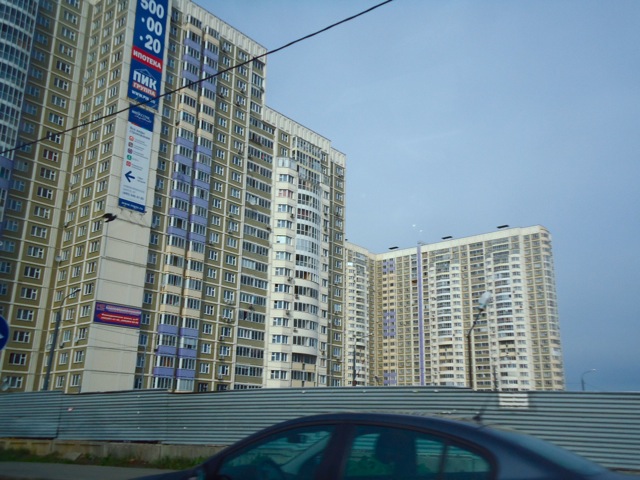
Rows and rows of new apartments in the exurban expanses of Kurkino

Wednesday, May 9, 2012

Scenes from Victory Day season in Moscow

Victory Day (день Победы) remains one of the most important Russian holidays. Recent years have seen the celebrations return to Soviet chest-thumping, with marching phalanxes of troops, rumbling tanks and ICBMs, and fighter jet fly-bys.

But as with any big holiday, it is also an occasion for a season of kitsch.


A Victory Maypole? This collision of banners and colors was on Krimskiy Val, across the street from the entrance to Gorky Park.


For fans of military history, this huge map of the campaign was installed at Revolution Square.


"Everything is important!" — This somewhat cryptic remark is the slogan of a housing developer, which sponsored this ad near Barrikadnaya. It's a very common Victory Day theme that is disturbing: young children dressed up in WWII-era uniforms and themes. It is intended as a sign of respect, but it also wants to signal the unquestioning readiness of future generations to make horrific sacrifices.


"The Motherland Salutes You, Hero-Fried Meat Pastry!" —this poster was spotted in the window of a chebureki shop on Ulitsa Solyanka, near Kitai Gorod.

Tuesday, May 8, 2012

What changed after Bolotnaya?


I spent the whole winter watching in surprise and amazement at what was happening in Moscow. Back in June when it seemed we would spend the year there, I wasn't looking forward to it. A year in a grim, expensive, depressed city where everything stays the same forever (except when they get worse). If the outcome of several exciting months is precisely what any safe bet would have been a year ago — Putin taking the oath for another term in the Kremlin — the very process, I thought, must have changed something.

So when we went to Moscow last week for family matters, I had my eyes and ears open. And on Sunday, the day before Putin's inauguration, I had the chance to see to see the state of civil society for myself.

The gathering was organized at Bolotnaya Square, scene of the first great moment back in December which already feels like ancient history. Despite being a sprawling megacity, Moscow's heavy-handed top-down authority keeps the chaos to a minimum, and we could tell something was up once we got to the Metro and announced several stops in the center were entirely shut down. The closest we could get was Novokuznetskaya, and since we'd already missed the march portion of the event, which was on a parallel street, we got out there and walked along the river.

That gave us a chance to the police staging area just east of the square. Lined up along the bridge just east of the square was some sort of staging area. The word "phalanx" is one I'd never really thought about, but there it was. Row after row, several deep, of fully-equipped riot police, in helmets and face shields, body armor and batons, just standing, waiting to be pointed at something. Coming upon them gave me a sense of the shock and awe of an 18th century battlefield, of coming over a hill and seeing the enemy all ready, with their shit together, ready to jump on you. It almost feels like that alone is half the battle. In this case, it was far more menacing because there was not display function in any of this. This was the backstage area, not even a show of force. 


We walked along the river to the entrance. Bolotnaya Square is a peculiar little stretch of asphalt on the south side of the long, narrow island that sits in the middle of the Moscow River. Geographically, it is incredibly close to the Kremlin, but practically, it is another world. It is accessible only by a handful of bridges. We crossed one, going through the first police checkpoint, which led to the western end of the square. From there we were channeled into it, toward where they had set up a stage and sound system, which was blaring classic Russkie Rock hits from Kino, and Nautilius Pompilius. On our right was the river, on our left, behind a row of port-a-johns and temporary metal fences, were a full line of police men.

We spent awhile as people streamed in, and watched the group. It was very diverse. There were certainly a lot of young people, the kind I would imagine attending an anti-establishment protest in the West. But there were older people, who looked like they'd been in the spirit of protesting their whole lives. A few had clearly anarchist signs, others outright Soviet nostalgia. But most were perfectly normal-looking middle class people, a few brought their kids.

As everyone filed in, I made note of what I thought must be a major achievement in the creation of Russian civil society: the whole thing was pretty boring. There wasn't much happening. It was a strange feeling: overall, it felt as if the authorities had made peace with the idea of larger-scale protest. The march was permitted, and more or less kept to the shape of several earlier peaceful ones which had gone off without a hitch under much more uncertain circumstances (i.e., it wasn't perfectly clear the regime had won yet). There were rumors that troublemakers were interested in starting some sort of "Occupy" camp near the Kremlin at Manezh Square, and we saw one hippie-looking lad on the subway carrying an LL Bean outlet's worth of camping gear, but we figured just a few fools would get themselves arrested. It seemed like everything was going to be boring, and the greatest challenge was going to be to figure out how to sustain the momentum through the long, long years stretched out ahead.

Everything shifted quite abruptly. Everyone who had gone ahead of us seemed to at once stop, turn around, and start walking back. Word spread through the crowd that the organizers of the event — Nemtsov, Navalny, Udaltsov, I believe —had been turned away (or had refused to go through). There appeared to be a sudden, intense stand-off behind us. Everyone had turned around. Someone from the perfectly superfluous stage announced that the meeting had been cancelled. It was hard to figure out what was going on, and so we began to make our way home.

We didn't hear about the violence until much later when we arrived home. Everyone was looking in the direction of what was happening, but we couldn't make anything out. The worst we saw was an NTV television van getting a working over. It was already piled with rubbish, and a crowd was pelting it with trash as we walked by. A line of indifferent police officers were standing a few feet away. I saw a perfectly respectable, middle-aged woman, who looked like she could have been a middle school art teacher, appear at my shoulder and hurl a glass bottle at the van, with an indescribably angry face. It was perhaps the only moment of real nervousness I felt, like a mob was about to turn very ugly. Meanwhile, back at the Square, things had already turned ugly, when a few provocateurs and an army of hyped up police goons made the news that would be seen around the world.

We made our way back toward Ordynka. It was our last night in Moscow, and my hankering for ethnic food led me to suggest we stop for dinner at Shesh-Besh, a decent Azeri chain restaurant, for some shashlik. The restaurant crowd was familiar from any Moscow restaurant — lots of well-dressed people, families with kids, everyone with smartphones, a scene almost Western. But I noticed that almost every single person there had a white ribbon on them.

Coming into this week, this is what I imagined the real value of these protests had been. The worst part about semi-authoritarian regimes is how alienating and atomizing they are. For years you walked around the city, and could never tell what the faces you saw on the street really thought about the political situation. If you hated Putin, aside from your family and close friends, you felt very alone. That all began to change with social media, and with the first stirrings of protest — when those intimate, desperate conversations around the kitchen table (an almost permanent feature of Russian life) were suddenly shared with perfect strangers in public.

Putin's actual inauguration was just as depressing as could be imagined. We watched it having a long breakfast, just before we set about packing for our trip home. The whole thing struck me as some kind of very dumb Disney princess movie, with an OJ car chase in the middle. People who try to deconstruct the details of it — the single camera, the general atmosphere of a very lame, scripted, "reality t.v." show — are forgetting something. Medvedev's inauguration four years ago was precisely the same, the same fetishized pomp and symbolism for no real point.

All this, with the violence, made it even more depressing than I was prepared for. I was ready to admit that while the battles were lost, the struggle wasn't over. That the gains painfully made would not be given up. That the focus would become smaller, on municipal and regional councils, on the hard work of living for a cause and building something beyond the occasional grand gesture. That thanks to social networks and alternate media there was no way the regime could carry on as before. That the sheer weight of corruption, official bullshit, and the countless, needless aggravations that make up life in Russia had finally tipped over and couldn't be set back. That maybe, for the first time in its long history, Russia would experience the kind of gradual, positive social change that would lead to peace and prosperity.

Then I caught myself; that's just wishful thinking. All Russians really have now is exactly what they had before: not much.

Wednesday, April 25, 2012

Kaboom


Spring sprung at Füvészkert (Botanical Gardens) in the VIII District last Saturday.

Monday, April 23, 2012

'One or two secret policemen along the way'

There is a line in Anne Applebaum's review of Masha Gessen's new book about Putin that that is so inaccurate and mendacious I can't believe it appeared in print, let alone in the New York Review of Books. Describing Yuri Andropov's response to the 1956 Hungarian Revolution, when he was the Soviet ambassador to Budapest, she writes,

He had been shocked when young Hungarians first called for democracy, then protested against the Communist establishment, and then took up arms against the regime, even lynching one or two secret policemen along the way. 

First a factual note about those "one or two secret policemen along the way." On Oct. 30, 1956, a mob lynched at least 24 AVH conscripts at Köztársaság Square. A photographer for Life magazine was at the scene, and it's tough viewing if you agree with me that murder is murder, no matter who does what to whom. 

But just as bad is her glib effort to make 1956 fit her world view. The uprising was remarkable for the breadth of its support -- young and old -- led first and foremost by left-wing, Marxist intellectuals and students who wanted a better form of socialism. They were joined a huge outpouring of support, including from many veterans of the extreme right. One eyewitness recalled that the uprising included the first reappearance of open anti-Semitism in Budapest since the Holocaust. 

By clumsily tromping outside her area of "expertise," she's let her stereotypes and assumptions show, and provide an insight into the Russophobic recesses of the neoconservative soul. This mix of provincial arrogance and willful ignorance is tragedy when we stumble into avoidable wars and prop up dictators, comedy when George W. Bush gets shoes instead of flowers thrown at him, and irrelevant when authentic people-led movements for social change -- in Serbia in 2000, across the Arab world last year, and in Russia right now. 

There's something pathetic about this unending desire to keep fighting the Cold War. Applebaum has plenty of places that will pay her for these thoughts, which she has honed as a fellow at the American Enterprise Institute and which have been feted by the most dishonest intellectual engineering project in Europe. So how she became NYRB's designated Russia expert is a mystery.

Thursday, April 19, 2012

Giorgio Perlasca and the banality of decency


Among the things we need to remember about the Holocaust is the role of redemption. It is something I think about whenever I look out our window, which faces an apartment building that had been one of the city's safe-houses for Jews set up by Giorgio Perlasca. Like Raoul Wallenberg and Carl Lutz, he used diplomatic cover to help save thousands of Budapest's Jews. Unlike them, he doesn't get nearly as much recognition. I've wondered if part of the reason is that he was a fascist.

There are no simple stories, and every one is bent to make some sort of argument. You'll hear a lot about Wallenberg this year, and rightly so. This Swedish diplomat saved many, at great personal risk, and as long as there are people around we should remember that we are capable of such bravery. But there is another dimension to his legacy. His mysterious disappearance — at the hands of the invading Soviets — creates a neat narrative that right-wingers and neo-cons cherish: a direct connection between the evil of fascism with the evil of communism. And it is a convenient way to downplay the fact that Nazism was defeated only by the incredible sacrifice of the Red Army, and little else.

Perlasca's story is complicated. He was a full-throated fascist, although of the more melodramatic Italian model. He willingly fought in Mussolini's absurd neo-colonial adventures in Africa, and went as a volunteer to fight for Franco in the Spanish Civil War. He later said that he became disillusioned in the late 1930s, when Mussolini adopted Germany's anti-Semitic tones.

During the war, Perlasca was in Budapest working as a supplier for the Italian military, and was here when Italy collapsed and dropped out of the war. The avoid going home, he took up an offer of Spanish citizenship for his service during the civil war.

The Holocaust came to Hungary soon after. The events here have a particular horror, because the Horthy regime, an eager ally of the axis powers, was certainly anti-Semitic but not quite exterminationist. They dragged their feet for years, but by 1944, as the war grew more and more desperate, pressure grew, and through the summer and fall deportations began. Eventually, Horthy was ousted in favor of Hungary's own homegrown fascist goons, who took the savagery to a new level.

It was those very dark years when people like Wallenburg, and Lutz, and Perlasca realized what was happening and could not stand aside. Perlasca, with the Spanish consul Angel Sanz Briz, began arranging dubious protection papers for Jewish families. When Sanz was sent to Switzerland, Perlasca stayed behind and cunningly pretended to represent the Spanish government in Sanz's absence. All told, over 5,000 Jews were protected. 

This building, on the north end of
Szent Istvan Park, was
one of Perlasca's houses
There was something desperate about their work, especially as all they could do was buy time. There was one famous anecdote about when Perlasca personally took two Jewish children off a deportation train, sparking a confrontation with an armed SS officer. According to the story, Adolph Eichmann himself, who was overseeing the work, appeared and let him go, advising the SS man that "we'll get them eventually." Only the capture of the city by the Soviets in January 1945 stopped the horror.

Perlasca (and especially Sanz, who had a long diplomatic career for Franco after the war) would not speak about what they did, and remained completely unacknowledged for forty years. It wasn't a simple story, and the only true thing, perhaps is the title of the 1993 book about Perlasca written by Enrico Deaglio, entitled, The Banality of Good.

Thursday, April 12, 2012

Whittling down in Florence


I realized early in our planning about Italy that we would face a welcome problem: too much. In our travels these recent years, we've spent a long time in places (Russia, Hungary), and had plenty of time to get to know them. Or we've been to places, like Croatia or Montenegro, where choosing what to do was a process of searching out and adding up. Italy, on the other hand, is a merciless process of whittling down. This is how we managed to leave town without seeing Michelangelo's "David" at the Accademia di Belle Arti Firenze.

We weren't there nearly long enough. The first things that struck me, walking away from the train station to find our hotel as it began to get dark, was that Florence has a much more pronounced bustle. If Venice is about elegant decay, Florence seems to be about chaotic improvisation. There were more crowds — helped by the seriously narrow streets — more filth, more noise, more smells. There was traffic everywhere crawling along, and a jumble of languages in the streets.

It seemed that every second building held a hotel of one sort or another. The abundance of lower-end options is staggering. Our hotel, I imagine, wasn't much different than many. It was owned by a very friendly fellow, who had the charming quirk of not letting his poor English get in the way of an earnest effort to conduct a meaningful and helpful conversation. Our room was absurd enough to be charming. For many years, a key part of the American in Europe experience was enduring strange hotel rooms, with their weird bathroom fixtures and aggressively lived-in vibe. So our place was positively retro. The furniture was mismatched, the bathroom was so small I couldn't fit into it if I squared my shoulders, and it had a small balcony that faced onto the courtyard of an Asian restaurant, so the smell of cooking oil would frequently waft up whenever we opened the door. Perhaps the strangest furnishing was an enormous, brand new, LCD screen television which took up one of the walls. I had no idea how to turn it on, and when I asked the owner, neither did he. There was a constant sound of running water, and our fellow guests were a rotating cast of working-class Germans, backpacking Scandos, and for a few days, a ton of Asian tourists. But the place was affordable, right in the heart of the San Marco neighborhood, and nothing I've said should be construed as complaining.

The first morning we began with that orientation shot, and walked down Via San Gallo to the Duomo. Nothing really prepares you for the size of this thing — you just never see an edifice like that, anywhere, let alone with the explosion of colors that you can know about but can't anticipate. Though the inside is somewhat overwhelming, we spent a good long time just walking around it. I think it must be clear by now that in Italy, I did a lot of staring.

Most of our days were a blur of holy spaces, as we spent a long time at San Marco, and Santa Croce, and Santa Maria Novella. We took the bus up to Piazzale Michelangelo and watched a sunset, we took pictures from the Ponte Vecchio, we spent a full day at the Uffizi (after having to buy scalped tickets because I didn't have the forethought to order ahead).

Our five-year old daughter kept her spirits up well, thanks in large part to a treasure-hunt style activity book my wife had the genius to buy right off the bat. I often wonder what is going through her mind when we take her places — in moments of frustration I'll point out to her that I didn't even have a passport until I graduated from college, but that's lost on her. We faced a few foreseeable problems — magnificent Renaissance churches are only so exciting — and some unforeseen. On our first morning, she lost a little plastic dog toy when she dropped it down into the grate of the Baptistery. Even though she only got it the night before at McDonalds, she was inconsolable for a few minutes. The pain vanished later on when we bought her a Pinnochio puppet, which was our constant companion for the rest of the trip.

In general, I think Mila enjoyed Italy because they truly love kids. In Eastern Europe, people in public have a fondness for children, but it comes with a hearty dose of contempt for their parents who are doing something wrong. Italians seem to take real, unabashed joy in children. I think every place we entered we were greeted with, "Ciao, bellissimma!" or "Ciao, Princessa!" Mila collected a number of freebies along the way — her favorite by far was when she insisted into going into a biker shop, and the scruffy, black leather-wearing shopkeeper gave her a Harley-Davidson keychain.

Tuesday, April 10, 2012

What to see in Venice

It's been several weeks since we returned from our too brief trip down to Italy, and it has taken me about that long to begin to sort out my thoughts on it. It is always terribly disorienting to actually do something that you always knew — at some level — you would do. And I've been dreaming about Italy since who knows when. 

I had a few days on my own in Venice, where since I was trying to do things on the cheap, I spent a lot of time walking around and getting as much out of a three-day vaporetto ticket as possible. It is the kind of place that makes you glad you have eyes -- so that was quite enough, to just see how the different parts add up to something fantastic. I spent a lot of time in the Cannaregio district -- a place that is somewhat off the well-beaten tourist track, where you are more likely to see boats toting things like kegs and mail than gondolas ferrying around other tourists. I had the strange sensation of stopping every now and then to look at a bridge, or a view down a canal, or a somewhat crumbling building. You stop, and then twenty minutes vanish. 

There were so many particular things that caught my eye:


— The floor of San Marco Basilica. Sure, the whole thing is a marvel, and you'll kink your neck for weeks from all the looking up, but don't forget to really look at the floor, the Escher-like patterns, and think about the long, deep roots of the Renaissance's revolution in pictorial perspective. 


— The color of the water. I took dozens of photos of the water, at different times of day, sometimes when it glowed gold reflecting the sun, or pink reflecting some fancy facade on the quay. Or sometimes when it was just its normal glow, from turquoise to slate blue. 


— As every responsible guidebook will tell you, getting lost is most of the fun. There is something delirious about stopping to check a map, getting your bearings, setting out, and instantly getting lost again. 


— I think my favorite thing to see, and I'm as surprised by this as anyone, was the roomful of Jackson Pollock's at the Peggy Guggenheim Collection. There are four of them on display in one of the rooms facing the Grand Canal. On each wall is a different moment in Pollock's career, and each work is both perfectly representative of what he was doing but individually quirky (the colors seemed somehow more elemental and lively — reds, oranges, yellows). And in such a perfect setting, with the blue of the water, the bright white walls of the palazzo, the lingering sense that this may have been the very room where Peggy treated her famous guests for bellinis... it adds up. 


— Seeing things like this: when it was time to leave for Florence, I bought my ticket at Santa Lucia and went back out onto the steps to gaze at the Canal and the square for a few more minutes. Out walk two young American backpackers, who looked just like the nicest, friendliest two kids to step off the campus of Vassar. They step out, quite literally wide-eyed, and stop in their tracks. "Wow," the boy exclaims. "I can't believe we made it!" the girl says. They gaze joyfully into each other's eyes and kiss like they're in a goddamn movie. I was so surprised there is a place on earth where unself-conscious things like this happen that I couldn't even bother to roll my eyes. I was too drowned in self-pity because I was leaving. 


The city gives you a long time to think about decay and the long slow end of things. You know that the city is doomed. You've heard about the glory days, the Republic and the Doge's who ruled the Mediterranean like it was their backyard. You know about the end of the Republic, the long years as a tourist mecca. The fact that the floods are getting worse as sea levels rise, that the foundations and stones aren't getting any younger. That more and more people are moving out of the city (to be honest, I thought this process was much further along: I was astonished at the number young parents bringing kids to school in my sestiere, or little old ladies with carts to carry their shopping. I had expected it to be full-on Epcot by now). You know all these things.

There is a lesson in there. Riding along the Grand Canal, looking at all the grand old palaces that line the waterfront. Many of them are empty, I heard. The conservation restrictions are so stringent, the cost of repair and maintenance so high, the uselessness of your often-flooded ground floor. It is the most splendid facade on earth. And I thought to myself about that day maybe three hundred years from now, when groups of Chinese tourists are traveling through Times Square. Once, I can hear the guide saying, this was the center of the universe. All over the world people saw the plays and films imagined here, read the books written and published here, bent to the will of the financial geniuses who ruled the world from their offices not a mile from here. And the tourists will admire it all, and struggle to imagine what that lost world was like.